Water Use and Solar Energy: How Much Water Do Solar Systems Need?
Solar energy is widely recognised as a renewable electricity source with relatively low environmental impacts during operation. However, one question is often overlooked: how much water does solar energy actually require?
The answer depends on the type of solar technology, how it is manufactured, the local climate and how the system is maintained. Conventional photovoltaic (PV) panels generate electricity directly from sunlight and do not require water for the electricity-generation process itself. However, water can be used during manufacturing, panel cleaning and construction.
Concentrating solar power (CSP) systems work differently. Some use heat to produce steam and generate electricity, which can require water for cooling as well as cleaning mirrors and other equipment.
Understanding these differences is important when evaluating the environmental impact of solar energy, particularly in regions where water resources are limited.
1. Do solar panels use water to generate electricity?
Conventional photovoltaic solar panels do not need a continuous water supply to generate electricity.
PV technology converts sunlight directly into electrical energy through semiconductor materials, usually silicon. Unlike conventional thermal power stations, it does not need to boil water to produce steam and drive a turbine.
This is an important difference between photovoltaic solar power and some other electricity-generation technologies.
However, it would be inaccurate to say that solar energy uses no water at all. Water may be required during several stages of the wider solar system lifecycle, including:
- Extracting and processing raw materials.
- Manufacturing photovoltaic cells and modules.
- Constructing solar power installations.
- Cleaning panels to remove dust and dirt.
- Cooling equipment in certain solar thermal systems.
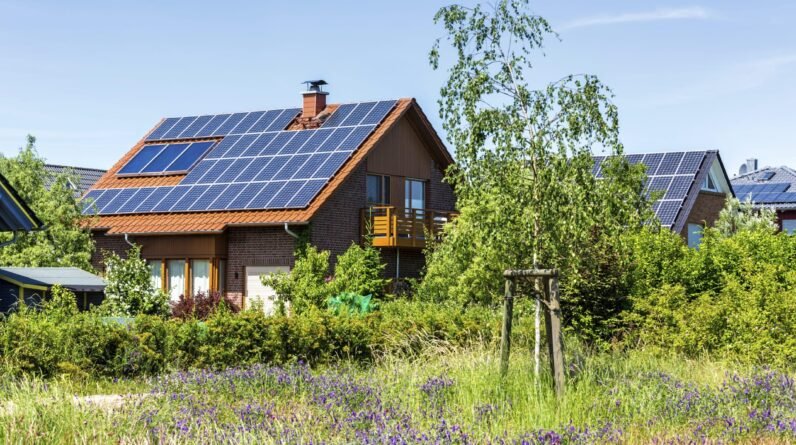
The amount used varies considerably. A rooftop PV installation in a rainy region may require very little cleaning water, while a large solar farm in a dusty, dry environment may need more frequent maintenance.
2. How much water does solar energy use?
There is no single water-use figure that applies to every solar installation. Water requirements depend on whether the system uses photovoltaic panels or concentrating solar power, how the equipment is manufactured, and how the installation is operated.
It is also important to distinguish between two measurements:
- Water withdrawal: The amount of water taken from a river, reservoir, groundwater source or public supply.
- Water consumption: The amount of water that is not returned to the original source, often because it evaporates or is incorporated into a process.
For example, a facility may withdraw water for cleaning and return most of it after treatment. Another facility may use water for cooling, with a portion lost through evaporation.
These figures should not be treated as interchangeable. A meaningful comparison of solar technologies should consider both withdrawal and consumption, as well as the local availability of water.
3. Water use in photovoltaic solar power systems
Photovoltaic solar systems generally have low operational water requirements compared with electricity technologies that depend on steam-cycle cooling.
However, water can still be used in three main areas.
Panel cleaning
Dust, pollen, bird droppings and other deposits can accumulate on solar panels. These materials may reduce the amount of sunlight reaching the cells and affect electricity production.
Water can be used to wash the panels, although the frequency of cleaning depends on local conditions.
Dust suppression and site maintenance
Large solar farms may use water to control dust during construction or maintenance. The amount required depends on the soil, site conditions, construction activity and environmental management plan.
Manufacturing and construction
Water can be required to produce silicon materials, process photovoltaic cells, manufacture modules and construct supporting infrastructure.
These activities occur before the panels begin generating electricity, but they form part of the overall water footprint of solar power.
The National Renewable Energy Laboratory’s research on electricity-generation water use identifies manufacturing and construction as important contributors to the lifecycle water requirements of photovoltaic systems.
4. Water consumption during solar panel manufacturing
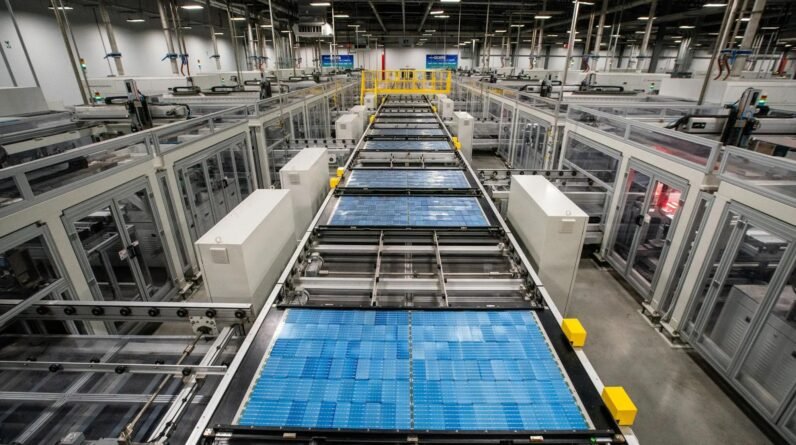
Solar panels require industrial production processes before they can be installed. Some of these processes use water for cleaning, processing and other manufacturing operations.
For conventional crystalline-silicon panels, water may be used during:
- Processing and purification of silicon materials.
- Cleaning silicon wafers.
- Photovoltaic cell processing.
- Cleaning and maintaining production equipment.
- Manufacturing and assembling finished modules.
The amount of water required varies by technology, manufacturing facility and production efficiency.
A study published in October 2025, Water Intensity of Photovoltaic Module Manufacturing at the Terawatt Scale, examined water requirements in photovoltaic manufacturing and highlighted substantial differences between published estimates.
The researchers found that some widely used literature estimates relied on data more than ten years old. Manufacturer sustainability reports suggested lower water use than several older estimates, highlighting the need for more current and consistent manufacturing data.
The study estimated that manufacturing enough silicon photovoltaic modules to reach one terawatt of rated capacity could require approximately 40–820 billion litres of water, depending on the assumptions and estimates used. This is a manufacturing-scale scenario, not the water consumption of an individual household solar installation.
The research also estimated approximately 410 billion litres for one terawatt of CdTe photovoltaic capacity, based on the available manufacturer data.
These figures demonstrate why manufacturing water requirements should be evaluated carefully and not presented as a single universal value for every solar panel.
5. Water used to clean solar panels
Solar panel cleaning is one of the most visible sources of operational water use for photovoltaic systems.
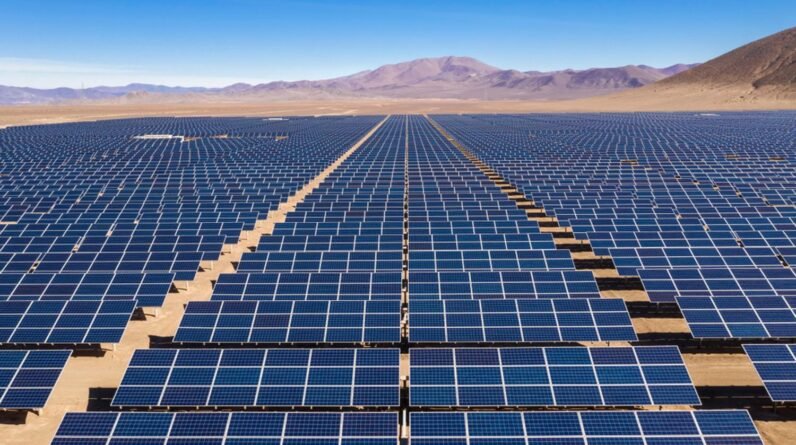
Panels exposed to dust, sand, pollen and other airborne particles may become dirty over time. In dry and dusty environments, soiling can reduce electricity production if deposits are not removed.
Water-based cleaning can restore panel performance, but frequent washing is not always necessary.
Cleaning requirements depend on:
- Local rainfall and climate.
- Dust and sand levels.
- Nearby agricultural or industrial activity.
- Panel angle and installation design.
- The amount of soiling and its effect on electricity production.
In some locations, rainfall removes much of the loose dirt naturally. In others, particularly dry regions with persistent dust, additional cleaning may be necessary.
Cleaning should therefore be based on actual site conditions rather than an assumption that every solar panel needs frequent washing.
For practical maintenance guidance, read our article on how often solar panels should be cleaned.
6. Water use in concentrating solar power systems
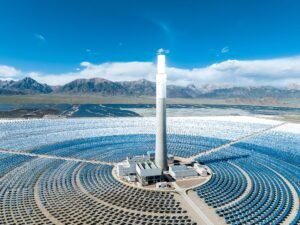
Concentrating solar power (CSP) is different from conventional photovoltaic technology.
Instead of converting sunlight directly into electricity, CSP systems use mirrors to concentrate sunlight and produce heat. That heat can be used to generate steam, which drives a turbine connected to an electricity generator.
Because some CSP plants use steam turbines, they require cooling systems. The amount of water used depends largely on the cooling technology.
There are three main approaches.
Wet cooling
Wet cooling uses water to remove heat from the steam cycle, commonly through cooling towers.
It can provide efficient cooling, but evaporation can result in significant water consumption. This can be a concern for CSP facilities in dry regions where water is already limited.
Dry cooling
Dry cooling uses air rather than water as the main cooling medium.
It can substantially reduce operational water requirements, making it an attractive option for some solar thermal facilities in water-stressed locations.
However, dry cooling can be more expensive and may reduce plant efficiency or electricity output, particularly during very hot weather.
Hybrid cooling
Hybrid cooling combines wet and dry cooling methods. It can reduce water use compared with a fully wet-cooled system while retaining some of the efficiency advantages of water-based cooling.
The choice depends on local climate, water availability, project economics and the required operating performance.
7. Photovoltaic solar versus concentrating solar power: Water-use differences
Photovoltaic and concentrating solar power systems have different water requirements because they generate electricity in different ways.
| Feature | Photovoltaic (PV) | Concentrating solar power (CSP) |
|---|---|---|
| Electricity generation | Direct conversion of sunlight into electricity | Uses concentrated sunlight to produce heat and drive a turbine |
| Water for electricity generation | No continuous water supply required | Depends on cooling system and plant design |
| Panel or mirror cleaning | May require water | Mirrors and collectors may require water |
| Cooling water | Not required for the PV conversion process | Wet-cooled systems use water; dry-cooled systems use much less |
| Water-use profile | Generally low during operation | Can be considerably higher with wet cooling |
The U.S. Department of Energy and National Renewable Energy Laboratory explain that photovoltaic facilities do not require water for cooling, while CSP facilities may require water for cooling depending on their design.
This distinction is essential when comparing solar power technologies. A water-use figure for a wet-cooled CSP plant should not be applied to a standard rooftop PV installation.
8. Can solar power put pressure on water supplies in dry regions?
Water use becomes especially important when solar installations are developed in areas that already experience water scarcity.
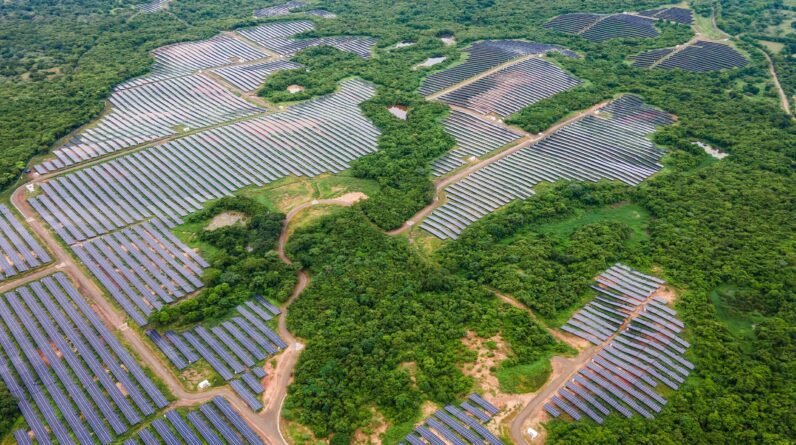
Many regions with strong solar resources have dry climates. These locations can be attractive for solar development because of their high levels of sunlight, but local water availability may be limited.
Potential concerns include:
- Competition with household and agricultural water needs.
- Additional demand on groundwater supplies.
- Pressure on local ecosystems that depend on rivers, lakes or groundwater.
- Greater difficulty maintaining large solar thermal facilities using wet cooling.
The U.S. Energy Information Administration notes that in dry environments, large volumes of water used for cleaning solar collectors and concentrators can affect ecosystems that depend on the same water sources.
Water planning should therefore be part of solar project development, particularly for utility-scale facilities in arid and semi-arid regions.
9. How solar power can reduce water-related environmental impacts
Solar developers and operators can use several approaches to reduce water demand without unnecessarily compromising electricity production.
Use photovoltaic technology where appropriate
PV systems do not need water for the electricity-generation process itself. They can therefore be a suitable option where reducing operational water demand is an important project objective.
Choose dry or hybrid cooling for CSP
Concentrating solar power projects can consider dry or hybrid cooling systems where water availability is limited. The trade-off between water consumption, operating costs and performance should be assessed before selecting a system.
Use efficient panel-cleaning methods
Cleaning should be based on actual soiling conditions and measured performance losses. Avoiding unnecessary washing can reduce water use.
Consider dry-cleaning technologies
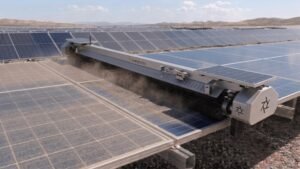
Some solar installations use brushes, robotic systems or other dry-cleaning methods to remove dust. These approaches may reduce or eliminate the need for water in certain environments, although their suitability depends on the panel surface, dust type and cleaning system.
Reuse and manage water responsibly
Manufacturers and solar power operators can improve water efficiency through suitable water-reuse systems, wastewater treatment and monitoring.
Consider local water availability during site selection
Water requirements should be evaluated before a project is approved. Choosing appropriate technology and cooling systems can help reduce pressure on local water resources
10. How does solar energy compare with other electricity sources in water use?
Water requirements differ across electricity-generation technologies. Thermal power plants commonly use water for cooling, while non-thermal technologies such as photovoltaic solar and wind generally have lower operational water requirements.
Coal, natural gas and nuclear facilities may use wet cooling systems that withdraw and consume water as part of their operation.
Photovoltaic systems avoid this steam-cycle cooling requirement. Their water footprint is more closely associated with manufacturing, construction and occasional cleaning.
Concentrating solar power is an important exception within solar energy because some CSP systems use steam cycles and wet cooling.
A National Renewable Energy Laboratory review of lifecycle water use found that photovoltaic and wind electricity generally had the lowest total lifecycle water use among the technologies evaluated, while thermoelectric generation technologies often required substantially more water.
However, comparisons should use consistent system boundaries. A fair lifecycle comparison needs to include water used in fuel extraction, component manufacturing, construction and operation, rather than looking at power plant cooling alone.
11. Is solar energy a water-efficient renewable energy source?
Photovoltaic solar energy is generally considered a water-efficient electricity source during operation because it does not need water to generate electricity or cool a steam turbine.
Its wider water footprint includes manufacturing, construction and maintenance. These requirements vary according to the technology, production process and local climate.
Concentrating solar power can have higher operational water requirements when wet cooling is used, although dry and hybrid cooling systems can reduce demand.
The most accurate conclusion is that solar energy is not completely water-free, but conventional PV systems generally have low operational water requirements compared with many thermal electricity technologies.
Frequently Asked Questions
Do solar panels use water to generate electricity?
Conventional photovoltaic solar panels do not require water to convert sunlight into electricity. However, water may be used during manufacturing, construction and panel cleaning.
How much water does a solar panel use?
There is no single figure for every solar panel. Water use depends on manufacturing technology, cleaning requirements, local climate and system design. A standard PV panel does not need a continuous water supply during operation.
Do solar farms use water?
Solar farms may use water for panel cleaning, dust suppression, construction and general site operations. Photovoltaic solar farms do not require water for the electricity-generation process itself.
Does solar panel manufacturing use water?
Yes. Water can be used during silicon processing, wafer cleaning, photovoltaic cell production and module manufacturing. The amount varies between manufacturers and technologies.
Why do concentrating solar power plants use water?
Some CSP systems use steam turbines to generate electricity. Wet-cooled plants require water to remove heat from the steam cycle, while dry-cooled designs use air to reduce water demand.
Do solar panels need to be washed with water?
Not always. Rainfall may remove much of the loose dirt in some climates. In dusty environments, additional cleaning may be required, but the frequency should depend on actual soiling and its effect on performance.
Can solar panels be cleaned without water?
Yes. Dry brushes and suitable robotic cleaning systems can remove dust from panels in certain conditions. Their effectiveness depends on the type of soiling, panel design and local environment.
Is photovoltaic solar more water-efficient than concentrating solar power?
Photovoltaic systems generally have lower operational water requirements because they do not need water for steam-cycle cooling. Some CSP plants use wet cooling and can consume considerably more water, although dry and hybrid systems reduce this demand.
Does solar energy use less water than coal?
Photovoltaic solar electricity generally has much lower water requirements over its lifecycle than coal-fired electricity. However, the exact comparison depends on the technologies, cooling systems and lifecycle boundaries being evaluated.
Can solar energy help reduce water consumption in the electricity sector?
Replacing some water-intensive thermal electricity generation with photovoltaic solar can reduce water requirements, particularly where the displaced power plants use wet cooling systems. The overall effect depends on the generation technologies and their water requirements.
Key Takeaways
- Conventional photovoltaic solar panels do not need water to generate electricity.
- Water is used in some stages of solar panel manufacturing and construction.
- Solar panels may require occasional cleaning, especially in dusty and dry environments.
- Concentrating solar power systems can use water for steam-cycle cooling and mirror cleaning.
- Wet-cooled CSP systems generally require more water than dry-cooled alternatives.
- Water withdrawal and water consumption are different measurements and should not be confused.
- Photovoltaic solar generally has low operational water requirements compared with many thermal electricity technologies.
- Efficient cleaning, water reuse and suitable cooling technology can reduce solar-related water demand.
Related Resources
- Environmental Impact of Solar Energy: From Manufacturing to Recycling
- Hidden Environmental Costs of Solar Energy
- Solar Panel Manufacturing and Environmental Impact
- Solar Panel Materials and Environmental Impact
- Solar Farms, Natural Habitats and Wildlife
- How Often Should You Clean Solar Panels?
- How to Clean Solar Panels on a Roof Safely
Further Reading and Sources
- U.S. Energy Information Administration – Solar Energy and the Environment
- McGott et al. (2025) – Water Intensity of Photovoltaic Module Manufacturing at the Terawatt Scale
- National Renewable Energy Laboratory – Concentrating Solar Power and Water Resources
- Meldrum et al. (2013) – Life Cycle Water Use for Electricity Generation: A Review and Harmonization of Literature Estimates
- National Renewable Energy Laboratory – Operational Water Consumption and Withdrawal Factors for Electricity Generating Technologies
- Solar Energy Industries Association – Water Use Management
- Systematic Review (2026) – Soiling Mitigation Strategies for Solar Photovoltaic Panels