Solar Panel System Cost: What Homeowners Should Expect
Installing solar panels is a major investment for any homeowner. Before requesting installation quotes, one of the first questions is usually: How much does a complete solar panel system cost?
The answer depends on several factors, including the size of the system, the equipment you choose, your roof condition, installation requirements and where you live.
In 2026, EnergySage reports an average residential solar installation price of approximately $2.60 per watt, with an average 12 kW system costing around $31,135 before incentives. However, smaller systems can cost considerably less, and prices vary between locations and installers.
Understanding the complete cost—not just the price of the solar panels themselves—can help you set a realistic budget and compare installation quotes.
In this guide, we’ll explain residential solar panel system costs, estimated prices by system size, the factors that influence installation expenses, available incentives and what homeowners should consider before investing.

Key Takeaways
- Solar system prices depend on system size, equipment, installation complexity and location.
- EnergySage’s 2026 marketplace data reports an average price of approximately $2.60 per watt.
- Its published system-size estimates range from $11,560 for a 4 kW system to $25,800 for a 10 kW system.
- A complete installation includes more than solar panels: inverters, mounting equipment, wiring, labor and permitting also contribute to the price.
- Adding battery storage can increase the upfront investment.
- The federal Residential Clean Energy Credit is no longer available for qualifying residential expenditures after December 31, 2025.
- Comparing multiple itemized installation quotes is one of the best ways to understand the value of a proposed system.
1. How Much Does a Solar Panel System Cost in 2026?
The cost of a residential solar panel system depends largely on how much electricity your household needs and how large an installation is required.
According to EnergySage’s June 2026 marketplace data, the average installed price is approximately $2.60 per watt, with an average 12 kW system costing around $31,135 before incentives.
This is a complete installed-system benchmark, not the price of solar panels alone.
Average solar panel system cost by size
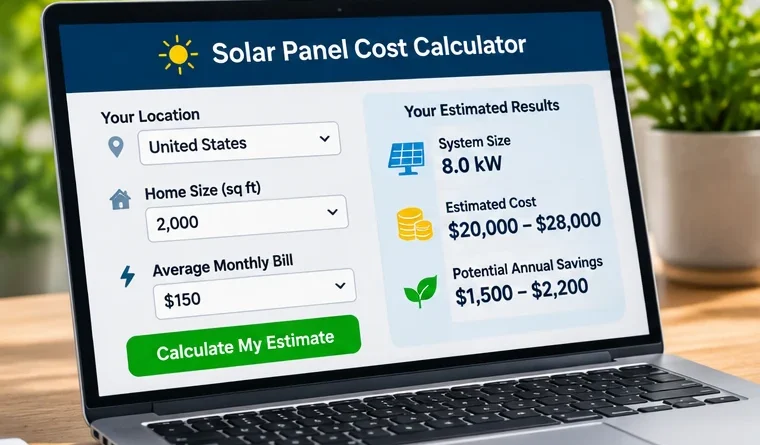
The following table uses EnergySage’s published 2026 system-size estimates.
| System size | Estimated installed cost before incentives |
|---|---|
| 4 kW | $11,560 |
| 5 kW | $13,900 |
| 6 kW | $16,080 |
| 7 kW | $18,340 |
| 8 kW | $20,960 |
| 9 kW | $23,130 |
| 10 kW | $25,800 |
<text>Source: EnergySage 2026 residential solar pricing data. These are marketplace estimates, not guaranteed installation quotes.</text>
A larger solar system generally costs more overall because it requires additional panels, equipment and installation work.
However, the cost per watt can decrease as system size increases because certain project expenses are shared across more installed capacity.
What does a typical home solar installation cost?
Consider a homeowner who needs a 6 kW solar system.
Based on EnergySage’s published estimate, the installation would cost approximately $16,080 before incentives.
A homeowner requiring an 8 kW system could expect an estimated price of approximately $20,960 before incentives.
These examples provide a useful starting point, but the final price depends on the property, location, equipment and installer.
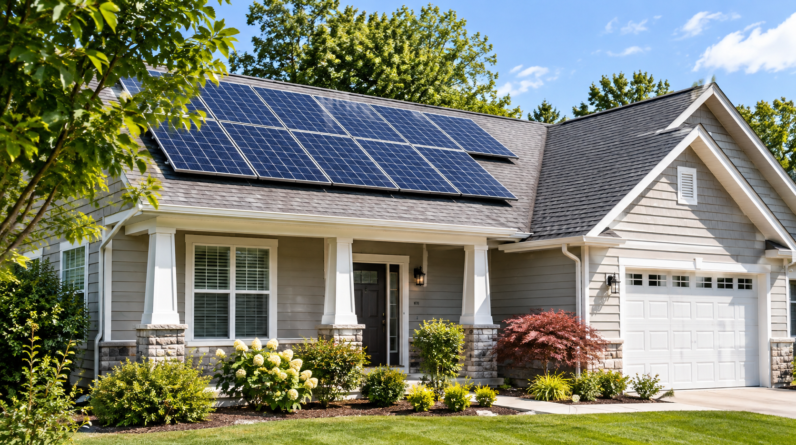
Image 1 – Place after this section
Suggested image: A modern American suburban home with a complete rooftop solar installation, showing the panels and the surrounding property.
ALT text: Residential solar panel system installed on a suburban home in the United States.
2. What Is Included in the Cost of a Solar Panel System?
When comparing solar installation prices, it is important to understand what you are actually paying for.
Solar panels are only one part of a complete residential solar installation.
A typical grid-connected system includes several components and services.
Solar panels
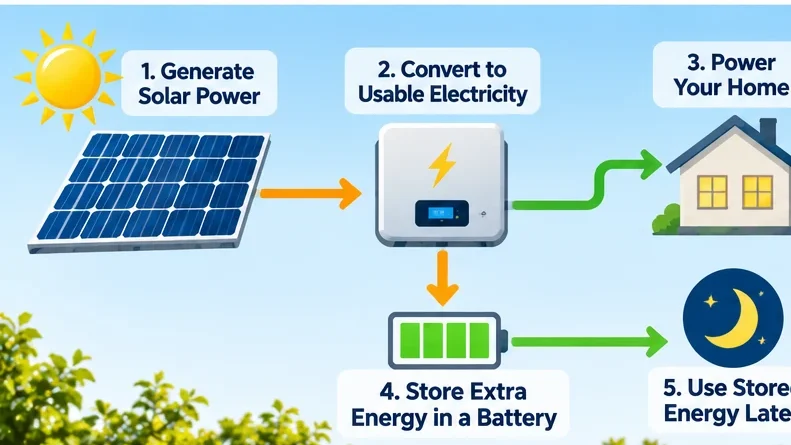
Solar panels capture sunlight and convert it into direct-current (DC) electricity.
The total panel cost depends on:
- The number of panels required.
- Individual panel wattage.
- Panel efficiency.
- Manufacturer and product quality.
- Product and performance warranties.
Higher-efficiency panels may cost more, but they can be useful when roof space is limited.
Solar inverter
Solar panels generate DC electricity, while most household appliances use alternating-current (AC) electricity.
An inverter converts the electricity into a form suitable for household use and, where applicable, export to the grid.
Depending on the installation, the system may use a string inverter, microinverters or another suitable inverter configuration.
Mounting and racking equipment
Mounting equipment secures the solar panels to the roof or another installation surface.
The cost depends on the roof material, installation design, mounting requirements and system configuration.
Electrical wiring and protection equipment
A solar installation also requires electrical connections, protective equipment and appropriate integration with the home’s electrical system.
The exact requirements depend on the installation design and local electrical regulations.

Installation labor, permits and inspections
A complete installation quote may also include:
- System design and engineering.
- Installation labor.
- Electrical work.
- Building and electrical permits.
- Inspection fees.
- Utility interconnection arrangements.
- Project management and other installer costs.
This explains why the price of a complete installed solar system is substantially higher than the retail price of the panels themselves.
EnergySage’s 2026 cost breakdown also shows that installation, overhead, sales and other project expenses represent meaningful portions of the total price.
3. What Factors Affect Solar Panel System Cost?
Two homeowners living in the same neighborhood can receive very different solar installation quotes.
The reason is that every property and energy requirement is different.
Here are the main factors that influence the final price.
System size and household electricity use
The size of your solar system is one of the biggest cost factors.
A household that uses more electricity may need a larger installation to offset a greater proportion of its energy consumption.
Your installer should consider:
- Annual electricity consumption.
- Monthly electricity bills.
- Local sunlight conditions.
- Roof orientation and available space.
- Expected household electricity demand.
A system should be designed around your actual energy requirements rather than simply choosing the largest available installation.
Solar panel efficiency and equipment quality
Solar panels differ in wattage, efficiency, product design and warranty coverage.
Higher-efficiency equipment can be particularly useful when roof space is limited.
However, choosing the most expensive panels does not automatically produce the best financial result.
Compare the complete system specifications, warranties, expected production and total installation price.
Roof condition and complexity
Your roof can have a significant influence on installation costs.
A relatively simple roof with good access may require less installation work than a property with multiple roof sections, steep slopes or complex architectural features.
Additional expenses may arise if your property requires:
- Roof repairs before installation.
- Additional mounting equipment.
- Structural improvements.
- Electrical panel upgrades.
- Extra installation labor.
If your roof needs replacement soon, it may be worth addressing that work before installing solar panels.
Location and local labor costs
Solar installation prices vary across the United States.
Factors include:
- Local labor rates.
- Installer competition.
- State and local regulations.
- Permit and inspection requirements.
- Equipment availability.
- Local utility interconnection procedures.
Your location also influences how much electricity a solar system can generate.
A system in an area with less sunlight may need additional capacity to produce the same amount of electricity as a comparable system in a sunnier location.
Installation complexity
Some properties require more complicated electrical or structural work than others.
For example, a system installed on a steep roof may require additional safety measures and labor.
Shading, roof obstructions and electrical upgrades can also influence the final price.
4. How Much Does Solar Battery Storage Add to the Cost?
A standard grid-connected solar installation does not necessarily include battery storage.
Solar batteries are optional equipment that can store electricity generated during the day for use later.
Adding a battery increases the upfront cost, but it can provide additional functionality.
Why homeowners add solar batteries
A home battery can help homeowners:
- Store surplus solar electricity.
- Use stored energy during the evening.
- Supply selected household circuits during an outage.
- Reduce dependence on electricity purchased from the grid.
- Manage electricity use when utility rates vary throughout the day.
The amount of storage required depends on your household electricity consumption and backup requirements.
What affects solar battery installation costs?
Battery pricing depends on:
- Storage capacity, measured in kilowatt-hours (kWh).
- Battery chemistry and manufacturer.
- Inverter compatibility.
- Backup equipment and electrical configuration.
- Installation labor.
- Whether the battery is installed with the original solar system or added later.
A battery designed to provide backup for essential appliances will have different requirements from one intended to supply most of a household during an extended outage.
Should you install solar panels with a battery?
Not every homeowner needs battery storage.
If your main goal is reducing electricity purchases while remaining connected to the grid, a solar-only system may be sufficient.
If backup power is important, or your utility’s electricity pricing makes stored energy valuable, a battery may be worth considering.
Compare the additional cost with the expected benefits before deciding.
For more information, explore our guides:
- How Does Solar Battery Storage Work?
- Solar PV Battery Storage
- Pros and Cons of Solar Battery Storage
5. Are There Solar Incentives and Rebates for Homeowners in 2026?
Incentives can influence the final cost of a solar installation.
However, homeowners need to distinguish between federal tax credits, state programs, utility rebates and other local incentives.
Important: The federal 30% residential solar tax credit has ended
The federal Residential Clean Energy Credit under Section 25D previously allowed eligible homeowners to claim a tax credit equal to 30% of qualifying residential clean-energy expenditures.
However, following legislative changes in 2025, the credit is no longer available for qualifying expenditures made after December 31, 2025.
The IRS confirms this termination date.
This means homeowners planning a new qualifying residential solar installation in 2026 should not automatically subtract 30% from their installation quote.
For details, consult the official IRS guidance:
IRS – Residential Clean Energy Credit
State and local solar incentives
Although the federal residential credit has ended, some homeowners may still qualify for other incentives.
Depending on your location, these may include:
- State solar rebates.
- State tax incentives.
- Local government programs.
- Utility-sponsored incentives.
- Performance-based incentives.
- Other renewable energy programs.
Eligibility, funding and program requirements vary.
Check the official energy agency and utility websites for your state before including any incentive in your budget.
Net metering and electricity export compensation
Some utilities compensate homeowners when their solar systems export surplus electricity to the grid.
The value of this exported electricity depends on the utility’s tariff and local regulations.
Net metering and other export-compensation arrangements can influence the financial value of a residential solar system.
Do not assume that every utility offers full retail-rate credits for exported electricity.

6. Should You Pay Cash or Finance Your Solar Installation?
Homeowners generally have several ways to pay for a solar installation.
The best option depends on available savings, financing terms, ownership preferences and how long you expect to remain in the property.
Paying cash
Paying cash means purchasing the system outright without taking out a solar loan.
Potential advantages include:
- No loan interest.
- No monthly financing payment.
- Direct ownership of the equipment.
- Greater control over the system.
The main disadvantage is the substantial upfront investment.
Solar loans
Solar loans allow homeowners to spread the purchase cost over a longer period.
Potential advantages include:
- Lower upfront payment.
- Direct system ownership, depending on the loan arrangement.
- Predictable monthly payments.
- The ability to retain long-term electricity savings.
However, interest, loan fees and financing terms can increase the total amount paid.
Compare the full loan repayment amount rather than focusing only on the advertised monthly payment.
Solar leases and power purchase agreements
A solar lease or power purchase agreement (PPA) allows a homeowner to use solar electricity without purchasing the equipment outright.
Under a lease, the homeowner generally pays a scheduled amount to use the system.
Under a PPA, the homeowner generally pays for the electricity generated by the solar system at an agreed price.
These arrangements can reduce the initial financial commitment, but ownership, payment terms, escalators, maintenance responsibilities and property-sale arrangements need careful review.
Compare the contract terms with the cost of purchasing a system.
7. How to Compare Solar Installation Quotes
Getting more than one installation quote can help you understand whether a proposed price is competitive.
However, comparing only the final dollar amount is not enough.
Two installers may quote different prices because they are proposing different equipment, system sizes or installation specifications.
Compare the system size
Check the proposed capacity in kilowatts (kW).
A larger system will generally cost more but may also generate more electricity.
Make sure the proposed system is suitable for your household’s electricity consumption.
Compare equipment specifications
Look at the following:
- Solar panel manufacturer and model.
- Panel wattage and efficiency.
- Inverter manufacturer and configuration.
- Mounting equipment.
- Battery specifications, if included.
- Product and performance warranties.
Compare estimated electricity production
Ask each installer for the expected annual electricity generation.
The estimate should account for roof orientation, shading, local weather and system design.
A cheaper installation is not necessarily the better option if it is expected to produce substantially less electricity.
Review the complete installation price
Ask for an itemized quote showing:
- Equipment.
- Installation labor.
- Permits.
- Electrical work.
- Roof-related expenses.
- Additional equipment.
- Financing fees, if applicable.
Make sure you understand which costs are included and which may be charged separately.
Check the installer
Before signing a contract, review:
- Installer experience.
- Appropriate licensing.
- Insurance coverage.
- Customer reviews.
- Product and workmanship warranties.
- Service and support arrangements.
A reliable installer should be able to explain the proposed system clearly and answer questions about the equipment, installation and expected performance.
8. How Much Can Homeowners Save With Solar Panels?
The upfront cost is only one part of the financial picture.
A residential solar installation can reduce the amount of electricity a household purchases from its utility.
However, the actual savings depend on several factors.
Household electricity consumption
Homes with higher electricity consumption may have more opportunity to offset grid electricity purchases.
The system should be designed around realistic household energy needs.
Local electricity prices
Electricity prices vary considerably across the United States.
A homeowner paying relatively high electricity rates may benefit more from generating their own electricity than someone with lower rates.
Solar system production
The amount of electricity generated depends on:
- System size.
- Location.
- Roof orientation.
- Panel angle.
- Shading.
- Weather.
- Equipment performance.
Utility export compensation
If your system generates more electricity than your home uses, the value of exported electricity depends on your utility’s compensation arrangement.
This can significantly affect overall savings.
Long-term ownership
Solar panels can operate for decades, although inverters and other components may require maintenance or replacement during that period.
When evaluating a solar investment, consider the expected electricity savings, equipment costs, financing, utility charges and future maintenance expenses.
Avoid relying on a guaranteed payback period or savings estimate without examining the assumptions behind it.
9. Is a Solar Panel System Worth the Cost?
For many homeowners, solar can be a worthwhile long-term investment, but the answer depends on the property’s suitability and the financial terms of the installation.
A solar system may be attractive when:
- Your roof receives sufficient sunlight.
- Your electricity bills are relatively high.
- Your roof is in suitable condition.
- Installation prices are competitive.
- Your utility’s export-compensation arrangements are favorable.
- You expect to remain in the property long enough to benefit from the system.
However, solar may be less attractive if your roof needs major repairs, has significant shading or requires expensive structural and electrical upgrades.
The best way to evaluate the investment is to compare the complete installed cost with realistic expected electricity savings over the system’s useful life.
Conclusion: Understand the Full Cost Before Going Solar
The cost of a residential solar panel system depends on more than the number of panels installed.
System size, equipment quality, roof condition, installation complexity, local labor rates and battery storage all influence the final price.
EnergySage’s 2026 marketplace data provides a useful starting point, with an average price of approximately $2.60 per watt and an average 12 kW installation price of around $31,135 before incentives.
However, your actual quote may be higher or lower depending on your home and location.
Take time to compare complete installation quotes, review equipment specifications and investigate any state or utility incentives that may be available.
Understanding these costs will help you make a more confident decision about whether solar is a suitable investment for your home.
Frequently Asked Questions About Solar Panel System Costs
1. How much does a solar panel system cost for a home in 2026?
Costs vary depending on system size, location, equipment and installation requirements. EnergySage’s 2026 marketplace data reports an average 12 kW system price of approximately $31,135 before incentives, with an average price of around $2.60 per watt.
2. How much does a 5 kW solar system cost?
EnergySage’s published 2026 system-size estimates put a 5 kW residential installation at approximately $13,900 before incentives. Actual prices depend on the property, equipment and installer.
3. How much does a 6 kW solar system cost?
EnergySage estimates an installed price of approximately $16,080 for a 6 kW system before incentives. This is a marketplace estimate rather than a guaranteed quote.
4. How much does an 8 kW solar system cost?
EnergySage’s 2026 published estimate for an 8 kW installation is approximately $20,960 before incentives. Roof complexity, equipment and local installation costs can affect the final price.
5. What is the average cost per watt for residential solar panels?
EnergySage’s 2026 marketplace data reports an average installed residential solar price of approximately $2.60 per watt. Other published benchmarks may differ because they use different datasets and methodologies.
6. Does the cost of solar panels include installation?
A complete installed-system quote generally includes solar panels, inverters, mounting equipment, wiring, installation labor and project-related expenses such as permits. Always check what is included in an individual quote.
7. Does adding a solar battery increase installation costs?
Yes. Battery storage adds equipment and installation expenses. The final cost depends on storage capacity, inverter compatibility, backup requirements and electrical work.
8. Is the 30% federal solar tax credit still available in 2026?
No. The federal Residential Clean Energy Credit under Section 25D is not available for qualifying residential expenditures made after December 31, 2025. Homeowners should investigate applicable state, local and utility incentives separately.
9. Is it cheaper to pay cash or finance solar panels?
Paying cash avoids loan interest and financing fees, but requires a larger upfront payment. Financing spreads payments over time but can increase the total amount paid. Compare the complete purchase and repayment costs before choosing.
10. How many solar panels does a typical home need?
The number depends on household electricity consumption, panel wattage, roof space and local sunlight conditions. An installer can estimate the required system capacity using your electricity bills and property details.
Key Takeaways
- Residential solar installation prices vary by system size and location.
- EnergySage’s 2026 marketplace data reports approximately $2.60 per watt.
- A complete installation includes equipment, labor and project expenses.
- Roof condition, electrical upgrades and installation complexity can increase costs.
- Battery storage adds to the initial investment.
- The federal 30% Residential Clean Energy Credit is no longer available for qualifying expenditures after December 31, 2025.
- Compare itemized quotes and realistic electricity production estimates before signing a contract.
Related Resources
Explore more guides from The Benefits of Solar Power:
- Solar Panels for Homes
- Learn How Solar Power Works
- Solar Panel Cost Calculator
- How Does Solar Battery Storage Work?
- Solar PV Battery Storage