



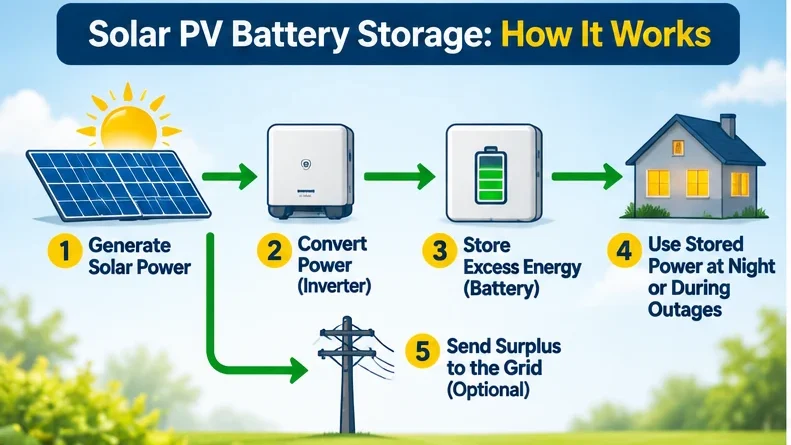
Solar PV Battery Storage: How It Works
Solar panels can generate electricity during the day, but household energy needs do not stop when the sun goes down. Solar PV battery storage brings solar panels, power electronics and a home battery together so that some of the electricity produced during daylight hours can be stored and used later.
Solar PV Battery Storage is essential for maximizing the efficiency of your solar power system.
For homeowners, the important question is not simply how a battery stores electricity. It is how the complete system works: how solar power reaches the home, when excess electricity charges the battery, how stored energy is delivered after sunset, and how the system interacts with the utility grid.
This guide explains the main components, common system configurations and practical considerations when adding battery storage to a residential solar PV installation.
Understanding Solar PV Battery Storage can significantly enhance energy independence.
What Is a Solar PV Battery Storage System?
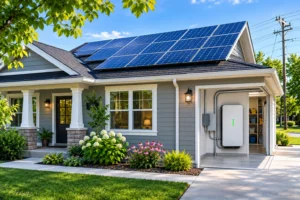
A solar photovoltaic (PV) battery storage system combines a solar array with a rechargeable battery and the equipment needed to control electricity moving between the panels, battery, home and grid.
Solar PV Battery Storage is a vital component that optimizes energy usage in homes.
The solar panels generate direct-current (DC) electricity. An inverter or power-conversion system manages the electricity so it can be used by household appliances, stored in the battery or exported to the utility grid, depending on the system design and operating settings.
In practical terms, the system can help a household use more of its own solar generation instead of relying entirely on electricity from the grid when solar production is low.
With Solar PV Battery Storage, homeowners can store energy for nighttime use.
The Main Components of a Solar PV and Battery System
Each aspect of a Solar PV Battery Storage system plays a crucial role in energy management.
1. Solar panels
Photovoltaic panels convert sunlight into DC electricity. The amount generated changes with sunlight, shading, panel orientation, weather and the size of the solar array.
2. Inverter or power-conversion equipment
Most household appliances use alternating-current (AC) electricity, while solar panels and batteries operate with DC electricity internally. Inverters convert and manage power between these forms. Depending on the design, a system may use a solar inverter, a battery inverter, a hybrid inverter or microinverters with separate storage equipment.
3. Battery storage
The battery stores electrical energy for later use. Its usable energy capacity is commonly expressed in kilowatt-hours (kWh). The battery’s power rating, expressed in kilowatts (kW), indicates how much power it can deliver at a given moment. These are different specifications: capacity describes how much energy can be stored, while power describes how quickly it can be supplied.
4. Energy management system
Controls and monitoring software help coordinate solar generation, household demand, battery charging and discharging, and grid imports or exports. The available operating modes depend on the inverter, battery and installer configuration.
Effective energy management in a home heavily relies on Solar PV Battery Storage.
5. Electrical panel, meter and grid connection
The home’s electrical panel distributes AC power to circuits. A utility meter records electricity imported from or exported to the grid according to the utility’s metering arrangement and applicable rules. A properly designed system also includes required disconnects and protection equipment.
How Electricity Moves Through the Complete System
The exact sequence depends on the system architecture and settings, but a typical grid-connected home system follows this general pattern:
-
- Solar panels generate electricity. Sunlight produces DC electricity in the PV modules.
- Power electronics convert and control the electricity. The inverter or conversion equipment makes power available in the form required by the home’s circuits and the battery system.
- The home uses available solar power. Household appliances draw electricity as they need it. Solar generation can reduce the amount of electricity the home needs to import.
- Surplus solar power can charge the battery. When generation is greater than the home’s immediate demand, the system may direct available excess energy into the battery, subject to its charging limits and settings.
Solar PV Battery Storage ensures that excess energy is not wasted but utilized effectively.
- Stored energy can be used later. When solar production falls or household demand rises, the battery can discharge to supply the home.
- The grid can provide or receive electricity. If the battery and solar system cannot meet demand, the home can import electricity from the grid. If generation exceeds household demand and battery charging needs, permitted surplus may be exported.
Some systems use a different priority order, allow grid charging, or reserve part of the battery for backup. The installer should configure the system around the homeowner’s goals, utility tariff and equipment capabilities.
What Happens During the Day, at Night and During an Outage?
During sunny hours
The solar array generates electricity. The home uses available solar power, and the system may send surplus generation to the battery. Once the battery reaches its configured charge limit, additional surplus may be exported to the grid if the interconnection and utility arrangement allow it.
Having Solar PV Battery Storage allows for greater efficiency during peak energy times.
In the evening and overnight
Solar production decreases or stops after sunset. The battery can then discharge to support household loads. If the battery reaches its reserve level or cannot supply the full demand, the home draws the remaining electricity from the grid, unless it is designed to operate independently.
During a power outage
Having solar panels and a battery does not automatically mean every home circuit will keep working during a blackout. Many standard grid-connected solar systems shut down when the grid fails for safety reasons. Backup operation requires compatible equipment, suitable isolation and control arrangements, and circuits configured for backup.
Solar PV Battery Storage can provide significant advantages during outages by supplying power.
Some installations back up selected essential circuits, while others are designed to support a larger portion of the home. The amount of time backup lasts depends on usable battery capacity, power demand, solar conditions and system configuration. Ask the installer exactly which circuits are backed up and whether the solar array can recharge the battery during an outage.
AC-Coupled vs. DC-Coupled Solar Battery Storage
One of the main design choices is how the battery connects to the solar PV system. The two common approaches are AC coupling and DC coupling.
DC-coupled systems
In a DC-coupled arrangement, the solar array and battery connect on the DC side through compatible power-conversion equipment. Depending on the design, a shared hybrid or bidirectional inverter can manage energy moving between the PV array, battery and AC circuits.
- Can be a practical choice when solar panels and a battery are installed together.
- Can reduce the number of separate conversion stages for some charging paths.
- Requires equipment designed to work together and must be sized around the PV array and battery.
AC-coupled systems
In an AC-coupled arrangement, the solar PV system has its own inverter, while the battery connects through a separate battery inverter. Both systems connect on the home’s AC electrical side.
- Can be useful when adding storage to an existing grid-connected solar installation.
- Can offer flexibility when the existing solar inverter is retained, subject to compatibility.
- Power may pass through additional conversion stages when charging or discharging, depending on the energy path.
Neither arrangement is automatically best for every home. The right choice depends on whether the solar system is new or existing, inverter compatibility, equipment warranties, backup requirements, available space, installation costs and the design proposed by the installer.
Can You Add a Battery to an Existing Solar PV System?
In many cases, yes. A homeowner with an existing grid-connected solar array may be able to add battery storage, but the available options depend on the inverter and the system’s electrical design.
Incorporating Solar PV Battery Storage into existing systems can greatly enhance functionality.
An AC-coupled battery may be suitable where the existing solar inverter can remain in place. In other situations, a hybrid inverter or other equipment changes may be considered. Before choosing a retrofit, ask an installer to check:
- The make, model and age of the existing inverter.
- Whether the inverter supports battery integration or backup operation.
- Available space and electrical capacity for the battery and associated equipment.
- Whether the proposed battery is compatible with the inverter and monitoring system.
- How the retrofit affects warranties, permits, utility approval and system performance.
What Should Homeowners Consider Before Choosing a System?

Consider how Solar PV Battery Storage can impact your energy independence and savings.
Household electricity use
Review when electricity is used, not only the total amount consumed. A home with high evening demand may value stored solar energy differently from a home that uses most of its electricity during daylight hours.
Battery capacity and power output
Compare usable capacity in kWh and continuous or peak power output in kW. A battery can have substantial energy capacity but still be unable to run several high-demand appliances simultaneously if its power rating is limited.
When evaluating options, remember that Solar PV Battery Storage capacity is key to your energy needs.
Backup requirements
Decide whether the goal is to reduce grid imports, provide backup for essential circuits, or support more of the home during an outage. These goals can require different battery sizes, inverter capabilities and electrical configurations.
Solar PV Battery Storage helps in balancing energy demand and supply efficiently.
Utility rates and export compensation
The financial value of storing solar electricity depends partly on the difference between the price of electricity imported from the utility and the compensation available for electricity exported to the grid. Check the current rate plan and export rules for your utility; they vary by location and provider.
Installation, safety and warranties
Battery placement, electrical protection, ventilation or clearance requirements, permitting and inspection should be handled according to applicable codes and manufacturer instructions. Ask for written details of product warranties, workmanship coverage, expected operating limits and service arrangements.
Benefits and Limitations of Solar PV Battery Storage
Potential benefits
One of the potential benefits of Solar PV Battery Storage is increased energy autonomy.
- More use of home-generated solar power: stored energy can be used when the panels are producing little or no electricity.
- Greater control over energy use: some systems can be programmed around time-of-use rates or household demand.
- Backup capability: suitably configured systems can supply selected circuits or larger loads during a grid outage.
- Flexible system operation: monitoring and energy management features can help coordinate solar generation, storage and grid exchange.
Important limitations
Understanding the limitations of Solar PV Battery Storage is crucial for planning.
- Additional upfront cost: a battery adds equipment, installation and potentially electrical upgrade costs.
- Finite storage: a battery can only supply energy up to its usable capacity and power limits.
- Energy losses: charging and discharging are not perfectly efficient, so the energy later delivered is less than the energy used to charge the battery.
- Performance varies: results depend on weather, household demand, battery settings, equipment and utility rules.
- Backup is not automatic: outage operation requires compatible equipment and an appropriately configured system.
Watch: How Solar Plus Battery Storage Systems Work
This video illustrates how rooftop solar, a home battery and the electricity grid can work together in a hybrid system.
This video explains how Solar PV Battery Storage interacts with energy systems.
Key Takeaways
Key takeaways include the importance of Solar PV Battery Storage in modern energy solutions.
-
- Solar PV battery storage combines a solar array, power-conversion equipment, a battery and energy controls.
- The home can use solar electricity as it is generated, store surplus energy, and use stored power later.
- AC-coupled and DC-coupled systems connect the battery to the solar array in different ways.
- Existing solar installations may be suitable for a battery retrofit, depending on inverter compatibility and system design.
- Battery capacity, power output, backup configuration and utility rates all affect how useful a system will be.
- Solar panels and a battery do not guarantee whole-home backup during an outage; the system must be designed for backup operation.
Solar PV Battery Storage is essential for ensuring energy reliability and sustainability.
Frequently Asked Questions About Solar PV Battery Storage
1. What does solar PV battery storage mean?
It means pairing a solar photovoltaic system with a rechargeable battery so that some of the electricity generated by the panels can be stored and used later.
2. How does a solar PV battery system work?
Solar panels generate DC electricity. Inverters and control equipment manage the power for household use, battery charging and grid exchange. Stored electricity can later be discharged to support the home’s electricity demand.
3. Does a solar battery store DC or AC electricity?
Battery cells store energy electrochemically using DC. In an AC-coupled system, power is converted to AC and then back to DC for battery charging; in a DC-coupled system, the battery connects on the DC side through suitable conversion equipment.
4. What is the difference between AC-coupled and DC-coupled storage?
DC-coupled storage connects the battery and solar array on the DC side. AC-coupled storage connects the battery through its own inverter on the AC side. The best arrangement depends on the existing equipment and the installation goals.
5. Can a solar battery power a home at night?
Yes, if the battery has stored enough usable energy and the inverter can supply the household load. If demand exceeds the battery’s available energy or power, the home may need to import electricity from the grid.
Solar PV Battery Storage can effectively power homes during periods of low sunlight.
6. Will solar PV battery storage work during a power outage?
Only if the system includes compatible backup equipment and is configured to isolate the home safely from the grid. Some systems back up selected circuits rather than the entire home.
7. Can I add battery storage to my existing solar panels?
Often, but not always. The existing inverter, battery compatibility, electrical design, available space and backup requirements determine which retrofit options are suitable.
8. What is the difference between battery capacity and power output?
Capacity, measured in kWh, indicates how much energy a battery can store. Power output, measured in kW, indicates how much electricity it can deliver at one time.
Understanding the differences in Solar PV Battery Storage can guide your choices.
9. Does a solar battery charge from the grid?
Some systems allow grid charging, while others may restrict it or offer configurable schedules. The feature depends on the battery and inverter, system settings, utility tariff and applicable rules.
10. Is solar PV battery storage worth it for every home?
No. Its value depends on the household’s electricity-use pattern, utility rates, export compensation, battery and installation costs, backup needs and available incentives. Compare the expected benefits with the full installed cost before deciding.
Related Solar Resources
For more insights, explore additional resources on Solar PV Battery Storage.
- How Does Solar Battery Storage Work? – understand the basic operating principles of solar batteries.
- Solar Panels for Homes – explore the main considerations when planning a residential solar installation.
- How Solar Power Works – learn how photovoltaic systems generate electricity.
- Solar Panel Cost Calculator – estimate solar costs and potential savings using your own assumptions.