How Does Solar Battery Storage Work?
Solar panels often generate the most electricity during daylight hours, but many households use a large share of their electricity in the evening. A home solar battery helps bridge that gap by storing some of the electricity produced during the day so it can be used later.
Understanding how does solar battery storage work is essential for maximizing energy efficiency in your home.
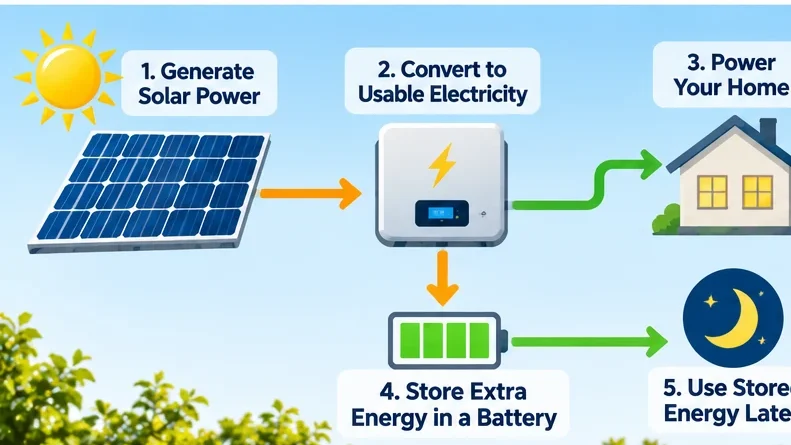
But how does solar battery storage work? In simple terms, solar panels generate electricity, a control and inverter system directs the power, and surplus energy charges the battery. When solar production falls or household demand rises, the stored energy can be converted into electricity for the home.
To grasp how does solar battery storage work, it is important to realize that the efficiency of your systems relies on how well the battery manages surplus energy.
This guide explains the process step by step, including the role of the inverter, how batteries charge and discharge, the difference between AC-coupled and DC-coupled systems, and what happens during a power outage.
In this guide, we will explore how does solar battery storage work, breaking down the important components of the system.
What Is Solar Battery Storage?
Solar battery storage is a system that stores electricity generated by a solar photovoltaic (PV) installation. Instead of sending all surplus solar electricity to the utility grid, a home can direct some of that energy into a battery.
It’s crucial to understand how does solar battery storage work to utilize the full potential of renewable energy in your household.
The stored electricity can then be used later, such as after sunset, during periods of low solar production, or during an outage if the system is designed and configured for backup operation.
This is where knowing how does solar battery storage work can greatly benefit homeowners looking for energy independence.
A solar battery does not create electricity. It stores electricity produced by the solar panels—or, if the equipment and settings allow, electricity drawn from the grid—and makes that energy available at another time.
By understanding how does solar battery storage work, you can ensure that your system is set up for optimal performance.
How Does Solar Battery Storage Work? Step by Step
Let’s take a closer look at how does solar battery storage work, starting from the generation of electricity to its usage.
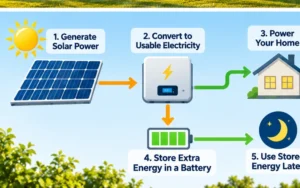
Step 1: Solar panels generate electricity
When sunlight reaches the photovoltaic cells in solar panels, the panels produce direct current (DC) electricity. The amount generated changes with sunlight, weather, shading, panel orientation and time of day.
Step 2: The inverter manages the electricity
Most household appliances use alternating current (AC) electricity, while solar panels and batteries operate with DC electricity. An inverter or hybrid inverter converts electricity between these forms and helps manage the flow between the panels, battery, home and grid.
Step 3: The home uses the electricity it needs
Solar electricity can power household appliances while the panels are generating. The system’s controls determine how available electricity is distributed according to the installation design and its settings.
Step 4: Surplus electricity charges the battery
If solar generation is greater than the home’s immediate electricity demand, the system can send surplus electricity to the battery, provided the battery has room to charge and the system is configured to prioritize storage.
In this step, we will highlight how does solar battery storage work when the solar generation exceeds household needs.
Step 5: Stored electricity is used later
When solar generation falls below household demand, the system can discharge the battery and supply electricity to the home. This commonly happens in the evening or overnight. If the battery reaches its reserve level or runs out of usable energy, the home may draw electricity from the grid.
How does solar battery storage work in the evening when the demand rises is crucial for any homeowner to understand.
What Happens to Solar Energy During the Day and at Night?
Understanding how does solar battery storage work can help you manage your energy consumption more effectively.

A typical grid-connected solar-plus-battery system may operate differently throughout the day:
Each time you utilize the stored energy, think about how does solar battery storage work in your system.
- Morning: Solar panels begin generating electricity as daylight increases. The home uses solar power, and the battery may begin charging if there is surplus generation.
- Midday: Solar production may be higher. Household demand is served, the battery charges, and any remaining surplus may be exported to the grid depending on system settings and utility rules.
- Evening: Solar generation declines. The battery can discharge to supply some household demand.
- Overnight: The home may use remaining battery energy and then draw from the grid if needed.
This is a general example. Actual power flows depend on the battery’s state of charge, household demand, weather, system configuration, utility tariff and the homeowner’s backup reserve settings.
What Does the Inverter Do in a Solar Battery System?
Understanding the inverter is critical in comprehending how does solar battery storage work effectively.
The inverter is a key part of a solar-plus-storage system. Solar panels produce DC electricity, batteries store electricity in DC form, and most home circuits use AC electricity. The inverter and associated controls convert power as needed and coordinate how energy moves through the system.
Some systems use a hybrid inverter designed to work with both solar panels and a battery. Other installations use separate inverters for the solar array and battery. The right arrangement depends on whether storage is installed at the same time as the panels or added to an existing solar system.
AC-Coupled vs. DC-Coupled Solar Batteries
Home batteries are commonly connected to solar systems in one of two ways: AC coupling or DC coupling.
This article will help you understand how does solar battery storage work by explaining both AC and DC coupling.
AC-coupled battery systems
In an AC-coupled system, the solar inverter first converts the panels’ DC electricity into AC electricity. Surplus AC power is then converted back to DC by the battery inverter for storage. When the battery supplies the home, its DC electricity is converted back into AC.
In analyzing how does solar battery storage work, consider the advantages and disadvantages of AC-coupled systems.
This arrangement can be convenient when adding a battery to an existing solar installation because the original solar inverter may remain in place. Multiple conversion steps can introduce additional energy losses.
DC-coupled battery systems
In a DC-coupled system, solar panels and the battery connect through a shared hybrid inverter or compatible power electronics. Solar DC electricity can charge the battery without first being converted to AC and then back to DC.
This can reduce conversion steps, but compatibility and installation requirements matter. It may be a suitable design for a new solar-and-battery installation, while retrofitting an existing system can be more involved.
To make the most of your energy, it’s essential to know how does solar battery storage work.
Neither arrangement is automatically best for every property. Ask the installer to explain the proposed design, expected system efficiency, equipment compatibility and future expansion options.
Can Solar Batteries Power a Home During a Power Outage?
To ensure your home can run during outages, it’s vital to explore how does solar battery storage work.
They can, but only if the solar-plus-battery system includes the required backup capability and is installed and configured for it.
Many ordinary grid-connected solar systems automatically shut down when the utility grid fails. This is an important safety measure that helps prevent electricity from being sent onto power lines while utility workers may be repairing them. Having solar panels alone therefore does not necessarily mean your home will have power during a blackout.
A backup-capable battery system uses suitable switching and inverter equipment to isolate the home—or selected circuits—from the grid during an outage. Depending on the system, it may supply essential loads such as lights, refrigeration, communications and selected outlets.
Some systems can also use solar panels to recharge the battery during a prolonged outage, if the inverter, controls, battery state and sunlight conditions allow it. Backup operation is not identical across products, so confirm exactly what the proposed equipment can do.
How Long Can a Solar Battery Power a Home?
There is no universal answer. Backup duration depends on the battery’s usable energy capacity, the power being drawn by appliances, conversion losses, battery reserve settings and whether solar panels can continue charging the battery.
Two measurements are especially useful:
- Energy capacity (kilowatt-hours, kWh): how much energy the battery can store and deliver within its operating limits.
- Power output (kilowatts, kW): how much electricity the battery can supply at one time.
For example, a battery with 10 kWh of usable energy could theoretically supply an average 1 kW load for about 10 hours before accounting for losses, reserve settings or changes in load. This is a simplified illustration, not a prediction of how long a particular home will run.
Gather information on how does solar battery storage work to better understand its limitations.
For a more detailed explanation of storage sizing, see our future guide to solar battery storage capacity once it is published.
Do Solar Batteries Charge From the Grid?
Some home battery systems can charge from the utility grid as well as from solar panels. Whether this is available depends on the battery, inverter, software settings, utility rules and the installer’s configuration.
In some areas, homeowners may use grid charging to take advantage of lower off-peak electricity rates or to prepare for expected outages. However, grid charging does not mean the stored electricity is solar-generated. If your goal is to store only surplus solar power, check the system’s operating settings.
What Happens When the Battery Is Full?
When the battery reaches its configured maximum state of charge, it stops accepting additional energy. If the solar panels continue generating more electricity than the home is using, the surplus may be exported to the grid, subject to the utility’s interconnection and export rules. Some systems may limit or curtail solar production if export is restricted and no storage capacity is available.
When reaching this point, it’s important to think about how does solar battery storage work related to energy export.
What Are the Main Benefits and Limitations?
Potential benefits
- Store surplus daytime solar generation for later use.
- Increase the share of household electricity supplied by the home’s own solar system.
- Reduce grid electricity purchases at certain times, depending on utility rates and export compensation.
- Provide backup power during outages when the system is properly configured.
Important limitations
-
- Some energy is lost during battery charging, storage and discharging.
- A battery adds equipment, installation and maintenance considerations.
- Backup power depends on compatible equipment and system configuration.
- Battery capacity and power output limit how much of the home can be supported and for how long.
- Performance and operating settings vary by manufacturer and installation.
When assessing the benefits, always consider how does solar battery storage work in your specific context.
Watch: How Solar Battery Storage Works
Add a verified educational video showing the flow of electricity between solar panels, an inverter, a home battery and household appliances. Confirm the video is available and technically accurate before publishing.
Key Takeaways
By knowing how does solar battery storage work, you can implement better energy strategies.
- Solar panels generate DC electricity during daylight hours.
- An inverter and system controls manage electricity for household use, battery charging and grid export.
- A solar battery stores surplus electricity so it can be used when solar production is low.
- AC-coupled and DC-coupled systems manage power conversions differently.
- Solar panels alone generally do not provide power during a grid outage; backup requires compatible equipment and configuration.
- Battery backup duration depends on usable capacity, power demand, system settings and solar availability.
Frequently Asked Questions
1. How does solar battery storage work?
This FAQ addresses how does solar battery storage work and related common concerns.
Solar panels generate electricity during daylight. The inverter and system controls direct electricity to household appliances and, when there is surplus generation, to the battery. Later, the battery discharges stored electricity to help power the home.
2. Do solar batteries store electricity as AC or DC?
Battery cells store energy in DC form. Inverters convert electricity between DC and AC so it can move between the battery, solar panels, household circuits and the grid.
3. Does a solar battery charge during the day?
It can charge during daylight when the solar panels produce more electricity than the home is using and the battery has available capacity. Charging behavior depends on system settings.
4. Can a solar battery power a house at night?
Understanding how does solar battery storage work at night can help you prepare for energy needs.
Yes, if it has enough stored usable energy and power output for the home’s demand. If the battery is depleted or its reserve limit is reached, the home may draw electricity from the grid.
5. Do solar panels work during a power outage if I have no battery?
Most standard grid-connected solar systems shut down during a grid outage for safety. A system needs suitable inverter and backup equipment to operate independently from the grid.
6. Will a solar battery automatically provide backup during a blackout?
Backup systems need to be configured correctly to know how does solar battery storage work during blackouts.
Not necessarily. The system must be designed and configured for backup, with compatible inverter and isolation equipment. Confirm which circuits are backed up and how the system behaves during an outage.
7. What is the difference between AC-coupled and DC-coupled batteries?
AC-coupled systems convert solar electricity to AC before converting it back to DC for battery storage. DC-coupled systems can send solar DC electricity to the battery through compatible equipment before conversion to AC for household use.
8. Can a solar battery be charged from the grid?
Some systems support grid charging. Availability depends on the equipment, settings, electricity tariff and applicable utility rules.
9. What happens when a solar battery becomes fully charged?
When discussing energy management, learning how does solar battery storage work becomes essential.
It stops accepting additional energy at its configured charge limit. Extra solar electricity may then be exported to the grid if permitted, used by flexible household loads or curtailed if export is restricted.
10. Does a solar battery provide electricity indefinitely during an outage?
No. Backup duration is limited by usable battery energy and household demand. Some systems can recharge from solar during an outage, but this depends on equipment configuration, sunlight and energy use.
Related Resources
These resources will help enhance your understanding of how does solar battery storage work.
Check this link to explore further on how does solar battery storage work in depth.
- Solar Battery Storage Price (add when published)
Sources and Further Reading
- U.S. Department of Energy: Solar and Resilience Basics
- EnergySage: How Do Solar Batteries Work?
- EnergySage: AC vs. DC Solar Battery Coupling
- Australian Government: Solar Batteries — technical explanation of battery operation and backup configuration.
- National Renewable Energy Laboratory: Technology Tips for Solar + Storage