Solar Panel Materials: Environmental Impact Explained – A Look at Solar Panel Manufacturing and Environmental Impact
Solar panels are often described as a clean source of renewable electricity, but what are they actually made of? Behind every photovoltaic panel is a combination of raw materials, metals, glass, polymers and specialised semiconductor components.
These materials must be extracted, processed and manufactured before a solar panel can generate electricity. Their environmental impact can include mining-related land disturbance, energy consumption, water use, industrial waste and pressure on certain mineral supply chains.
However, not all solar panels contain the same materials. Conventional crystalline-silicon panels have a different composition from thin-film technologies such as cadmium telluride (CdTe). Understanding these differences is important when assessing the environmental impact of solar panel materials.
In this guide, we examine the main materials used in solar panels, where they come from, their environmental implications and how recycling and material innovation can reduce resource demand.
Understanding the Solar Panel Manufacturing and Environmental Impact is crucial for consumers and industry stakeholders alike.
1. What materials are solar panels made of?
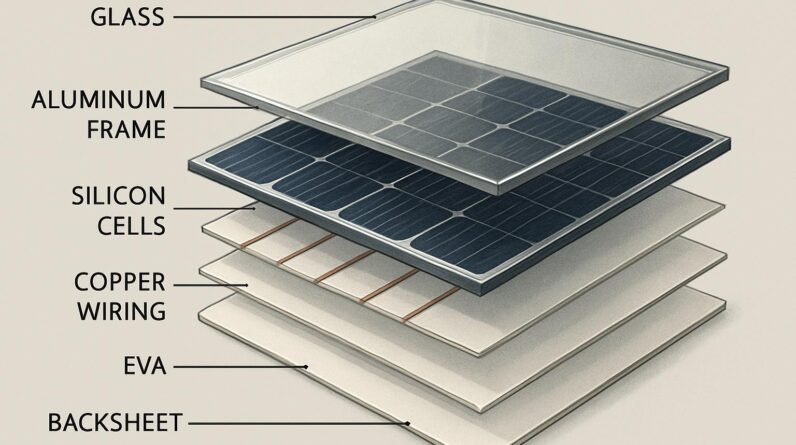
Most solar panels installed today use crystalline-silicon photovoltaic cells. A typical module contains several main material groups:
- Glass: Protects the solar cells and allows sunlight to pass through.
- Silicon: Acts as the semiconductor material that converts sunlight into electricity.
- Aluminium: Commonly used for the module frame and mounting structures.
- Copper: Used in electrical connections, cables and other system components.
- Silver: Used in electrical contacts that collect current from solar cells.
- Polymers: Provide insulation, encapsulation and protective backing.
- Other metals: Small quantities of materials such as tin, lead and zinc may be used in particular components or manufacturing processes.
The exact composition varies according to panel design, manufacturer and technology. Some materials are present in relatively large quantities, while others are used in very small amounts because of their electrical or chemical properties.
The U.S. Environmental Protection Agency identifies glass, aluminium, copper, silver and silicon among the materials found in conventional crystalline-silicon panels. It also notes that certain thin-film modules use different semiconductor materials.
2. Silicon: The main semiconductor material
Exploring the Solar Panel Manufacturing and Environmental Impact helps us make informed decisions for a sustainable future.
Silicon is the central semiconductor material in conventional crystalline-silicon solar panels. It is derived from silica-containing raw materials, including quartz, and must be processed and purified before it can be used in high-performance photovoltaic cells.
When sunlight reaches a silicon solar cell, the semiconductor material helps convert light energy into electrical energy.
Silicon is relatively abundant in the Earth’s crust. However, the fact that the raw material is widely available does not mean producing solar-grade silicon has no environmental impact.
The main environmental considerations include:
- Raw material extraction: Obtaining silica-rich materials involves mining or quarrying activities.
- Purification: Producing high-purity polysilicon requires industrial processing and substantial energy.
- Manufacturing waste: Cutting silicon ingots into thin wafers can result in material losses.
- Resource efficiency: Improving wafer thickness, production yields and material recovery can reduce the amount of silicon required per unit of solar capacity.
Silicon itself is not the same environmental concern as the energy and industrial processes required to transform raw material into a photovoltaic semiconductor.
Learn more about these processes in our article on solar panel manufacturing and its environmental impact.
3. Glass: The largest material component by weight
Glass is an important part of most conventional solar modules. It provides a protective surface while allowing sunlight to reach the photovoltaic cells.
According to the U.S. Environmental Protection Agency, glass makes up approximately 75% of the weight of a typical solar panel.
Glass is generally made from mineral raw materials such as silica sand, together with other ingredients used to achieve the required properties.
Its environmental considerations include:
- Extraction and processing of raw materials.
- High-temperature manufacturing that requires energy.
- Emissions associated with industrial production.
- Transportation of heavy glass components.
- Recovery and recycling when panels reach the end of their useful life.
Glass has an advantage from a resource-recovery perspective because established glass recycling industries already exist. However, recovering clean, reusable glass from a solar module can require separating it from encapsulants, cells and other bonded materials.
4. Aluminium: Frames and supporting structures
Aluminium is widely used in solar panel frames because it is lightweight, durable and resistant to corrosion. It can also be used in mounting and support structures.
The environmental impact of aluminium depends heavily on how it is produced.
Primary aluminium production requires energy-intensive industrial processes. Mining bauxite, refining it into alumina and producing aluminium metal can create environmental pressures, including:
- Land disturbance associated with bauxite mining.
- Energy consumption during refining and smelting.
- Industrial emissions.
- Waste generation from mineral processing.
Recycled aluminium can reduce the need for primary production and is an important material-recovery opportunity when solar panels are dismantled.
Aluminium frames are often easier to separate from a solar module than the materials embedded within the photovoltaic cells. This makes them a practical target for recycling programmes.
5. Copper: Electrical connections and energy infrastructure
Copper is used throughout solar power systems because it conducts electricity efficiently. It may be found in panel connections, internal wiring, cables, inverters and other electrical equipment.
Although copper is not usually one of the largest components by weight in a conventional solar module, it is important to the wider solar electricity system.
Copper mining and processing can create environmental impacts, including:
- Land disturbance and changes to local landscapes.
- Energy and water consumption.
- Mine waste and tailings management requirements.
- Potential risks to nearby water and ecosystems if operations are poorly managed.
Demand for copper may increase as solar installations, electricity networks and other electrification technologies expand.
The International Energy Agency Photovoltaic Power Systems Programme’s September 2026 material-flow report includes copper among the key materials assessed for future solar photovoltaic deployment.
Copper can also be recovered and recycled, helping reduce demand for newly extracted material.
6. Silver: A small quantity with an important function
Silver is used in many conventional silicon solar cells to form electrical contacts that collect and transport the current generated by the cell.
Although silver represents a small proportion of a panel’s total mass, it has an important electrical function.
Its environmental and resource considerations include:
- Mining and refining activities.
- Energy and water requirements during extraction and processing.
- Environmental impacts associated with mine waste and tailings.
- Growing demand as solar photovoltaic manufacturing expands.
Because silver is valuable, recovering it from retired panels may become increasingly important. Manufacturers and researchers are also working on ways to reduce silver use or substitute other conductive materials.
The IEA PVPS September 2026 report identifies silver as a material for which technology choices and material recovery could significantly influence future supply requirements. It also discusses the potential role of copper-based metallisation as an alternative.
7. Other materials: Tin, lead, zinc and polymers
Solar panels contain additional materials that may be less visible but still contribute to their performance and environmental footprint.
Tin
Tin can be used in solder and electrical connections. Its extraction and refining involve mining and processing activities, and future solar deployment could increase demand for this material.
Lead
Some crystalline-silicon modules use small quantities of lead in solder or electrical connections. The amount and location depend on the panel design. Lead requires responsible handling and waste management because it can be harmful if released into the environment.
Zinc
Zinc may be present in particular alloys, coatings and other components. Its environmental footprint depends on mining, processing, manufacturing and recovery practices.
Polymers
Plastic-based materials are used to encapsulate and protect solar cells, provide insulation and form parts of the backsheet or junction box. These materials help panels withstand weather conditions, but they can make end-of-life separation and material recovery more complicated.
These components illustrate why a solar panel cannot be evaluated by looking only at its silicon cells. The complete module contains several materials that must work together.
8. Thin-film solar panels use different materials
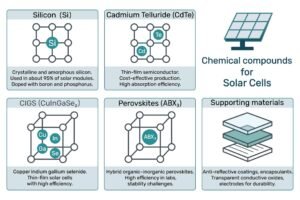
Not all photovoltaic panels use crystalline silicon. Thin-film technologies use very thin semiconductor layers deposited onto supporting materials such as glass, metal or plastic.
Two established thin-film technologies include:
Cadmium telluride (CdTe)
CdTe solar cells use a semiconductor compound made from cadmium and tellurium. The material absorbs sunlight and helps generate electricity.
The U.S. Department of Energy explains that cadmium and tellurium used in CdTe modules are obtained as by-products of zinc and copper mining, respectively.
Environmental considerations include responsible material processing, chemical handling, worker protection and appropriate end-of-life recovery. Cadmium requires particular care because of its toxicity.
CdTe modules are designed as complete photovoltaic products, so their normal use should not be confused with exposure to uncontained cadmium compounds. Proper manufacturing, product integrity, collection and recycling remain important.
Copper indium gallium diselenide (CIGS)
CIGS is another thin-film photovoltaic technology. Its semiconductor layer contains copper, indium, gallium and selenium.
These materials have their own supply-chain considerations. In particular, indium and gallium are used in several advanced technologies, so demand from multiple industries can influence their availability and supply chains.
The environmental impact of a thin-film module therefore depends on its particular composition, production process and recovery options.
For a broader comparison of photovoltaic technologies, see the U.S. Department of Energy’s information on solar photovoltaic manufacturing.
9. Are the materials in solar panels toxic?
The answer depends on the type of panel and the materials it contains.
Many of the materials in conventional crystalline-silicon panels, such as glass, aluminium and silicon, are common industrial materials. However, some modules may contain small quantities of substances such as lead in electrical connections.
Thin-film technologies can contain semiconductor materials such as cadmium telluride. These materials require appropriate controls during manufacturing, handling and recycling.
It is important to distinguish between the presence of a substance within a sealed, functioning product and the risks that may arise if the product is broken, improperly processed or disposed of incorrectly.
In the United States, whether a discarded solar panel is classified as hazardous waste depends on its characteristics and applicable regulatory testing. The EPA explains that some panels may be regulated as hazardous waste, while others may qualify for different waste-management pathways.
For this reason, old or damaged panels should be managed through suitable collection, recycling or disposal channels rather than handled as ordinary household rubbish.
10. Can solar panel materials be recycled?
Many of the materials used in solar panels can be recovered, although the difficulty and economic value of recycling vary by material and panel technology.
Materials with established or promising recovery routes include:
- Glass: A major component by weight and a potential source of recovered material.
- Aluminium: Frames can often be separated and recycled through established metal-recycling systems.
- Copper: Electrical connections and wiring can provide recoverable metal.
- Silver: Valuable material that may be recovered from photovoltaic cells.
- Silicon: Can potentially be recovered and processed for future use, although purification and processing requirements can be challenging.
- Specialty metals: Materials such as tellurium may be recovered through dedicated processes for certain thin-film technologies.
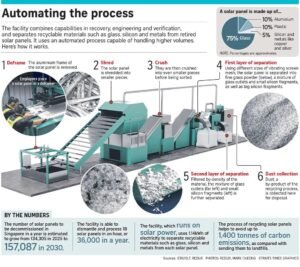
The U.S. Environmental Protection Agency describes several approaches to solar panel recycling, including removing the frame and junction box, separating glass from the cells and recovering metals through additional processing.
However, technical recyclability does not automatically mean that every material is currently recovered at high rates. Collection systems, processing costs, market demand and recycling infrastructure all influence what happens in practice.
Read more about solar panel end-of-life management and recycling in our lifecycle guide.
11. How future solar technology could reduce material impacts
Solar technology continues to develop, and material efficiency is an important part of making photovoltaic systems more sustainable.
Several approaches could help reduce environmental pressure from solar panel materials:
- Reducing silver consumption: Alternative electrical contacts and copper-based metallisation could reduce reliance on silver.
- Improving silicon efficiency: Better cell performance can increase electricity production from a given amount of material.
- Reducing manufacturing losses: More efficient wafer production can reduce silicon waste.
- Using recycled materials: Recovering aluminium, glass, silicon and metals can reduce the need for virgin resources.
- Developing alternative technologies: New photovoltaic designs may change the quantities and types of materials required.
- Designing for recycling: Products that are easier to disassemble can improve material recovery at the end of their useful lives.
The IEA PVPS September 2026 report examines future material flows under different solar deployment scenarios through 2050. It highlights the importance of material efficiency, substitution and recycling in managing future resource demand.
12. Do solar panel materials make solar energy environmentally harmful?
Solar panels depend on materials that must be mined, processed and manufactured. Some of these activities can cause environmental damage if they are not managed responsibly.
However, the existence of material-related impacts does not mean solar energy is environmentally equivalent to fossil-fuel electricity.
Solar photovoltaic systems generate electricity without burning fuel during operation. Their environmental performance should be assessed across their complete lifecycle, including material extraction, manufacturing, installation, operation and end-of-life management.
Solar panels generally have substantially lower lifecycle greenhouse gas emissions than fossil-fuel electricity sources. Their material requirements also create opportunities for better sourcing, improved efficiency and recycling as the industry develops.
The goal should be to reduce the environmental footprint of the materials used in solar technology while preserving the long-term benefits of generating electricity from sunlight.
Frequently Asked Questions
What materials are solar panels made of?
Most conventional solar panels contain glass, silicon, aluminium, copper, silver and polymers. Small quantities of other materials, such as tin, lead and zinc, may also be used. Thin-film panels have different semiconductor compositions.
What is the main material used in solar panels?
Silicon is the main semiconductor material in conventional crystalline-silicon solar panels. Glass is generally the largest component by weight in a typical module.
Do solar panels contain heavy metals?
Some solar panels contain small quantities of metals such as lead in electrical connections. Certain thin-film technologies use cadmium telluride. The materials and quantities depend on the panel technology and design.
Are solar panels toxic to the environment?
Solar panels are designed to operate as enclosed products. However, some materials require appropriate handling and end-of-life management, particularly if panels are broken, processed improperly or disposed of incorrectly.
Do all solar panels contain cadmium?
No. Conventional crystalline-silicon panels do not use cadmium telluride as their semiconductor. CdTe is used in a specific thin-film photovoltaic technology.
Is silicon environmentally friendly?
Silicon is abundant in the Earth’s crust, but producing high-purity solar-grade silicon requires energy and industrial processing. Its environmental footprint depends on extraction, purification, manufacturing efficiency and the energy supply used.
Why do solar panels use silver?
Silver is used in many silicon solar cells because it conducts electricity efficiently and helps collect the current generated by the cell. Manufacturers are researching ways to reduce silver use or replace it with alternative conductive materials.
Can aluminium and glass from solar panels be recycled?
Yes. Aluminium frames and glass are among the materials that can be recovered from solar panels. Separating glass from the other bonded components can require additional processing.
Are thin-film solar panels more harmful to the environment?
Not necessarily. Thin-film and crystalline-silicon technologies use different materials and manufacturing processes. A fair comparison requires lifecycle assessment rather than judging a panel by the presence of one particular material.
Will solar panel recycling reduce the need for mining?
Recycling can recover valuable materials and reduce demand for newly extracted resources. Its contribution will depend on collection rates, recovery efficiency, processing costs and the volume of panels reaching the end of their useful lives.
Key Takeaways
- Most conventional solar panels contain glass, silicon, aluminium, copper, silver and polymers.
- Glass makes up a large share of a typical panel’s weight, while silicon is the main semiconductor material in crystalline-silicon technology.
- Mining and processing materials can affect land, water, energy use and local ecosystems.
- Silver, copper and other metals are important to photovoltaic systems, even when used in relatively small quantities.
- Thin-film technologies such as CdTe and CIGS have different material requirements from crystalline-silicon panels.
- Some solar panel materials can be recovered, but technical recyclability does not guarantee that all components are recycled.
- Material efficiency, substitution, responsible sourcing and recycling can reduce the environmental footprint of solar technology.
Related Resources
- Environmental Impact of Solar Energy: From Manufacturing to Recycling
- Solar Panel Manufacturing and Environmental Impact
- Hidden Environmental Costs of Solar Energy
- Solar Panels Carbon Footprint: How It Compares With Fossil Fuels
- Negative Environmental Effects of Solar Energy
- Environmental Benefits and Drawbacks of Solar Energy
Further Reading and Sources
- U.S. Department of Energy – Solar Photovoltaics Supply Chain Review Report
- U.S. Department of Energy – Solar Photovoltaic Manufacturing Basics
- U.S. Department of Energy – Cadmium Telluride Solar Technology
- IEA PVPS (September 2026) – Primary and Secondary Material Flows for the Future Global Deployment of Silicon-Based Photovoltaic Systems
- U.S. Environmental Protection Agency – Solar Panel Recycling
- U.S. Environmental Protection Agency – End-of-Life Solar Panels: Regulations and Management
- IPCC – AR6 Working Group III, Chapter 6: Energy Systems