Solar Panel Cost Calculator: Estimate Your Savings
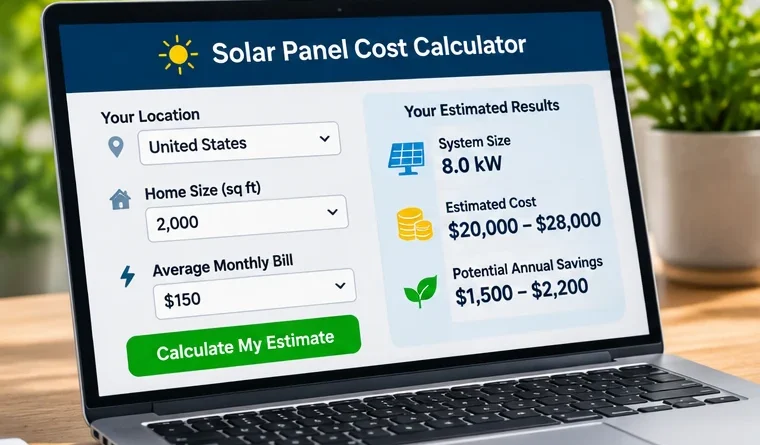
Wondering how much solar panels could cost for your home? This solar panel cost calculator helps you estimate the potential value of a residential solar system using your own electricity usage, installer quote, expected solar production and utility rates.
This Solar Panel Cost Calculator will help you understand the financial benefits of your solar investment.
Rather than relying on a generic national average, enter the figures from your electricity bill and solar proposal. The calculator estimates the value of the electricity your system may provide, a simple payback period and an illustrative long-term benefit. Actual results depend on weather, shading, system performance, utility rules, maintenance, financing and future electricity prices.
The Solar Panel Cost Calculator provides tailored estimates based on your unique data.
Solar Panel Cost Calculator
Using the Solar Panel Cost Calculator for Accurate Estimates

Make sure to utilize the Solar Panel Cost Calculator effectively by inputting accurate data.
“Solar electricity used directly at home” is the estimated share of generation consumed in the home instead of exported. The calculator limits self-consumption to your annual household use.
The Solar Panel Cost Calculator can significantly aid in understanding your solar investment.
This simplified estimate does not model panel degradation, changing electricity prices, tax treatment, financing interest, battery replacement, inverter replacement, utility fixed charges or changes to export compensation. It is not a quote, a promise of savings or financial advice.
How to Use the Solar Panel Cost Calculator
To maximize your results, use the Solar Panel Cost Calculator with real-time data.
- Enter the installed system price. Use the total cash price from a written installer quote. Include any additional project costs separately if they are not already included.
- Enter expected annual solar production. Use the installer’s estimated annual kilowatt-hour production, not the system’s panel wattage.
- Enter annual electricity use. Add the kilowatt-hours shown on your utility bills over a full year.
- Enter your electricity rate. Use the energy charge you actually avoid when solar electricity powers your home. Check your bill for time-of-use rates and fixed charges.
- Estimate direct solar use. Enter the share of solar generation you expect to consume at home rather than export. Ask the installer for an estimate if you are unsure.
- Enter your export credit. Use the compensation rate your utility actually pays or credits for exported electricity. Do not assume it equals the retail rate.
What Does the Calculator Estimate?
Reviewing the output of the Solar Panel Cost Calculator can help you make informed decisions.
Upfront system cost
The calculator adds your quoted installed price and any additional upfront costs you entered. It does not automatically subtract incentives or assume that a tax credit is available.
Annual electricity value
Electricity used directly in the home is valued at the retail rate you entered. Electricity exported to the grid is valued at your export-credit rate. This distinction matters because utility compensation for exported power can be lower than the price of electricity purchased from the grid.
Simple payback period
Simple payback divides the upfront cost by the estimated annual net benefit. It is a basic comparison, not a full financial model. It does not include loan interest, changes in utility rates, panel degradation, equipment replacement or the time value of money.
Illustrative 25-year net benefit
This figure multiplies the estimated annual net benefit by 25 and subtracts upfront cost. It assumes the annual value remains unchanged, so it should be treated as a simplified illustration rather than a prediction of lifetime savings.
What Affects the Cost of a Solar Panel System?
Understanding the components influencing costs through the Solar Panel Cost Calculator is essential.

- System size: larger systems generally cost more overall, although price per watt can vary with size.
- Equipment: panels, inverters, mounting hardware, monitoring and warranties differ by product.
- Roof and electrical work: roof complexity, structural work, electrical upgrades and access can affect project costs.
- Location: labor, permitting, utility interconnection and local market conditions vary.
- Battery storage: adding a battery increases upfront cost and changes how solar electricity can be used.
- Financing: loan fees, interest, leases and power purchase agreements change the total amount paid and who owns the equipment.
Why Your Utility’s Export Rules Matter
The Solar Panel Cost Calculator considers all variables affecting your potential savings.
Solar savings depend on what happens to electricity your home does not use at the moment it is generated. Some utilities offer net metering or bill credits; others use different export-compensation arrangements. Rates and eligibility can vary by utility, customer class and the date a system is interconnected.
Before relying on a savings estimate, check your utility’s current distributed-generation or net-metering tariff. The export-credit field in this calculator is deliberately user-entered so the result does not assume one national policy.
Are Federal Solar Tax Credits Included?
This calculator does not automatically include a federal tax credit. The IRS states that the Residential Clean Energy Credit is not available for qualifying expenditures made after December 31, 2025. Homeowners planning a new residential installation in 2026 should not assume the former 30% residential credit applies. State, local and utility incentives may differ; verify current eligibility with the official program administrator and consult a qualified tax professional where appropriate.
How to Get a More Accurate Solar Estimate
For a detailed estimate, the Solar Panel Cost Calculator will assist in evaluating your options.
- Collect 12 months of electricity bills, including total annual kWh.
- Ask installers for estimated annual production and the assumptions behind it.
- Get at least three itemized quotes using comparable equipment and system sizes.
- Confirm the utility’s export rate and any fixed charges that remain after installation.
- Ask whether roof repairs, electrical upgrades, permits and monitoring are included.
- Compare cash price and financing by total amount paid, not only monthly payment.
For more information, read our guide to solar system panel cost, our overview of solar panels for homes and our explanation of how solar power works.
Watch: How to Compare Solar Quotes and Estimate Savings
Learn how the Solar Panel Cost Calculator can simplify your solar project planning.
Add a verified video from a reputable U.S. energy education organization or consumer resource explaining solar quotes, system production estimates and utility compensation. Verify availability and current accuracy before publishing.
Key Takeaways
- A useful solar cost estimate starts with your actual electricity use, installer price and expected annual solar production.
- Electricity used in the home and electricity exported to the grid may have different values.
- Utility export rules can significantly affect the economics of a solar installation.
- Simple payback is only a basic estimate and does not replace a detailed financial analysis.
- Compare multiple itemized quotes and verify current incentives before making a decision.
Frequently Asked Questions
Our Solar Panel Cost Calculator FAQ section addresses common user inquiries.
1. How does a solar panel cost calculator work?
It uses inputs such as system price, annual solar production, household electricity use and utility rates to estimate the value of solar electricity and a simple payback period. Results depend on the assumptions and figures entered.
2. What information do I need to calculate solar panel costs?
For a useful estimate, gather an installed system quote, annual electricity use, estimated annual solar production, your retail electricity rate and the utility’s export-credit rate.
3. Are solar panel cost calculator results accurate?
They are estimates, not guaranteed prices or savings. Accuracy depends on the quality of the inputs and whether the calculation reflects your utility tariff, system design, financing and local conditions.
4. Should I use my monthly electricity bill or annual usage?
Annual electricity use in kilowatt-hours is generally more useful because it accounts for seasonal changes. Use a full 12 months of bills when possible.
5. Why does the calculator ask for an export-credit rate?
Electricity sent to the grid may be compensated at a different rate from electricity purchased from the utility. The export rate helps estimate the value of surplus generation.
6. Does this calculator include a solar battery?
It can reflect a battery if its cost is included in the installed system price. However, it does not separately model battery dispatch, backup value, round-trip efficiency or replacement costs.
7. Does the estimate include federal tax credits?
No. The calculator does not automatically apply tax credits or incentives. Check current IRS guidance and official state or utility program rules before including any incentive in your budget.
8. What is a solar panel system’s payback period?
It is the estimated time required for the system’s financial benefits to equal its upfront cost. A simple payback calculation does not account for all costs, financing, changing rates or the time value of money.
9. Why do solar estimates differ between calculators?
Calculators may use different assumptions for installation costs, solar production, retail rates, export compensation, incentives and system degradation. Compare the inputs and methodology, not just the final number.
10. Should I get quotes after using a solar cost calculator?
Yes. A calculator is useful for early planning, but installers must assess your roof, electrical system, shading, utility requirements and energy use to provide a site-specific proposal.
Related Resources
To further enhance your understanding, the Solar Panel Cost Calculator provides comparative insights.
Utilizing the Solar Panel Cost Calculator can help visualize your long-term savings.
Sources and Further Reading
-
- U.S. Department of Energy: Homeowner’s Guide to Going Solar
- Internal Revenue Service: Residential Clean Energy Credit
- National Renewable Energy Laboratory: Solar Market Research and Analysis
- DSIRE: Database of State Incentives for Renewables & Efficiency
- EnergySage: Solar Calculators and Solar Cost Guidance
Finally, remember that the Solar Panel Cost Calculator is a powerful tool for solar planning.