



Perovskite Solar Panels: The Next Generation of Solar Technology
Solar technology has improved significantly over the past few decades, but researchers are still looking for ways to make solar panels more efficient, affordable and versatile.
One emerging technology attracting considerable attention is perovskite solar panels.
Perovskite solar cells have achieved impressive efficiency improvements in laboratory research, and scientists are exploring ways to combine them with conventional silicon solar cells to generate more electricity from the same amount of sunlight.
But what exactly are perovskite solar panels? How do they work, what advantages could they offer, and when might homeowners be able to use them?
Although this technology has considerable potential, important challenges remain before it can compete with established residential solar panels on a large commercial scale.
In this guide, we’ll explain how perovskite solar technology works, examine its potential benefits and limitations, and explore what it could mean for the future of residential solar energy.
Key Takeaways
- Perovskite solar cells use a specially structured material that absorbs sunlight and converts it into electricity.
- Researchers have achieved rapid improvements in perovskite solar cell efficiency.
- Perovskite materials can be combined with conventional silicon cells to create high-efficiency tandem solar cells.
- Potential advantages include lightweight designs, flexible applications and lower-temperature manufacturing.
- Long-term durability, moisture resistance, manufacturing scale and environmental considerations remain important challenges.
- Some perovskite materials contain lead, requiring careful manufacturing, encapsulation and end-of-life management.
- Laboratory results should not be confused with commercially available rooftop products.
1. What Are Perovskite Solar Panels?
Perovskite solar panels are photovoltaic devices that use a material with a particular crystal structure known as a perovskite structure to absorb sunlight and generate electricity.
The name comes from the mineral perovskite, which has a specific crystal arrangement. Materials with a similar structure can be engineered for different applications, including solar energy generation.
In solar cells, researchers commonly use metal-halide perovskite materials because of their ability to absorb light and transport electrical charges.
Unlike conventional silicon solar cells, which use crystalline silicon as their main light-absorbing material, perovskite solar cells use a thin layer of engineered semiconductor material.
Why are perovskite materials attracting attention?
- They absorb sunlight effectively.
- Their optical and electronic properties can be adjusted through material composition.
- They can be processed using relatively low-temperature manufacturing methods.
- They can be deposited as thin layers.
- They can be combined with silicon in tandem solar cell designs.
The U.S. Department of Energy identifies high efficiency, potential manufacturing cost advantages and compatibility with tandem photovoltaic cells among the main opportunities for perovskite solar technology. These potential advantages still need to be demonstrated consistently in durable, commercially manufactured solar modules.

2. How Do Perovskite Solar Cells Work?
Perovskite solar cells generate electricity using the photovoltaic effect, the same basic principle used by conventional silicon solar panels.
When sunlight reaches the perovskite absorber layer, the material absorbs photons and generates electrical charges. These charges are separated and transported through other layers within the solar cell before being collected by electrical contacts.
The resulting electrical current can then be used to power electrical equipment or supplied to an appropriate electrical system.
The main layers of a perovskite solar cell
| Component | Main function |
|---|---|
| Transparent electrode | Allows sunlight into the cell and helps collect electrical current |
| Electron transport layer | Helps move electrons toward the appropriate contact |
| Perovskite absorber layer | Absorbs sunlight and generates electrical charges |
| Hole transport layer | Helps transport positively charged carriers |
| Back electrode | Completes the electrical circuit |
The exact design varies depending on the solar cell architecture. The perovskite absorber is particularly important because its composition influences how much sunlight the device can absorb and how effectively it converts that energy into electricity.
How is this different from conventional silicon solar technology?
Conventional silicon solar cells use crystalline silicon wafers as their main semiconductor material. Perovskite solar cells use thin engineered absorber layers that can be produced using different deposition and manufacturing techniques. This creates opportunities for lightweight and potentially flexible solar applications. It also allows researchers to combine perovskite and silicon materials in a single device.
3. What Are Perovskite-Silicon Tandem Solar Panels?
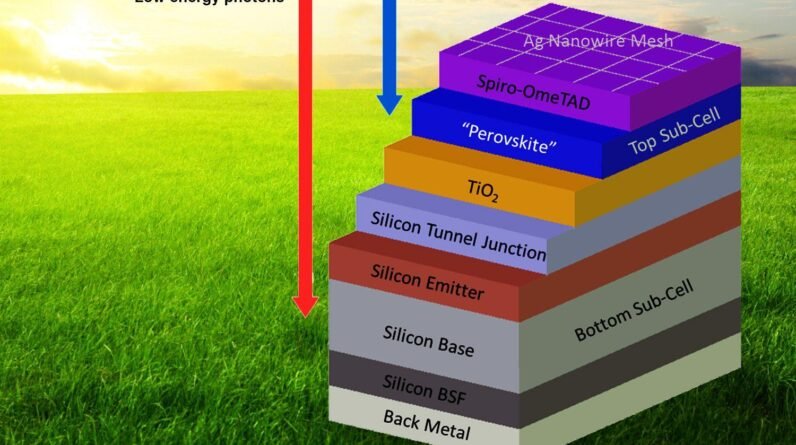
One of the most promising developments in perovskite solar research is the creation of tandem solar cells. A tandem solar cell combines two different light-absorbing materials so that they can capture different parts of the sunlight spectrum.
In a perovskite-silicon tandem design, a perovskite layer is placed above a conventional silicon solar cell.
- The perovskite layer absorbs higher-energy portions of sunlight.
- The silicon layer absorbs additional light that passes through the upper layer.
- The combined device can potentially generate more electricity from the same sunlight than either material could achieve alone.
This approach is important because conventional silicon solar cells face theoretical efficiency limits when used as single-junction devices. Combining different absorber materials provides a way to move beyond those limitations.
Why are tandem solar cells important?
Tandem technology could increase the amount of electricity generated from a given panel area. This may be particularly useful for properties with limited roof space. However, the real-world benefit will depend on commercial product efficiency, durability, installation costs and long-term performance.
Recent efficiency progress in 2026
Research published in Nature Sustainability in August 2026 reported a certified efficiency of 33.0% for a perovskite-silicon tandem solar cell. The same research demonstrated perovskite solar modules with an efficiency of 23.2%.
These results show progress beyond small laboratory cells toward larger module formats. However, the figures describe different device configurations and should not be confused with the expected efficiency of a commercially available residential solar panel. They also do not establish that the technology is ready for widespread rooftop installation.
4. What Are the Potential Benefits of Perovskite Solar Panels?
Perovskite solar technology offers several potential advantages that could influence the future of the solar industry. Some benefits are already demonstrated in research devices, while others depend on further manufacturing and durability improvements.
Higher solar cell efficiency
One of the biggest attractions of perovskite solar technology is its potential for high efficiency. Researchers have achieved rapid improvements in laboratory-scale perovskite solar cells. Combining perovskite with silicon in tandem configurations can push efficiency beyond the levels generally achievable with single-junction silicon devices.
For homeowners, higher efficiency could eventually mean generating more electricity from a smaller roof area. However, laboratory records should not be treated as guaranteed commercial panel performance.
Potentially lower manufacturing costs
Perovskite solar cells can be manufactured using relatively low-temperature processing techniques. Some manufacturing approaches involve depositing thin layers through solution-based or coating methods. These techniques could eventually reduce certain manufacturing costs and allow more flexible production processes.
However, lower processing temperatures do not automatically mean that complete commercial solar panels will be cheaper. Manufacturers must also account for encapsulation, quality control, material costs, production yield, testing and long-term reliability.
Lightweight and flexible designs
Some perovskite solar cell architectures can be produced on lightweight substrates. This could create opportunities for solar applications where conventional rigid glass panels are unsuitable, including building-integrated photovoltaics, lightweight building surfaces, flexible solar devices, certain portable power applications and specialized transportation applications.
Improved performance in tandem configurations
Perovskite materials can be engineered to absorb different portions of the solar spectrum. By combining two complementary absorber materials, researchers can potentially increase overall energy conversion efficiency. Commercial success will depend on achieving these improvements without compromising durability or affordability.
5. What Are the Main Challenges of Perovskite Solar Technology?
Despite its impressive research progress, perovskite solar technology still faces important challenges. The biggest question is not simply whether researchers can produce highly efficient solar cells. It is whether manufacturers can produce large, reliable solar modules that continue operating effectively outdoors for many years.
Long-term durability and stability
One of the biggest challenges is maintaining performance over an extended period. Perovskite materials can be sensitive to environmental conditions such as:
- Moisture
- Oxygen
- Heat
- Ultraviolet radiation
- Temperature changes
- Electrical operating stress
These factors can contribute to degradation and reduce the amount of electricity a solar cell produces. Researchers are investigating improved material compositions, protective coatings, encapsulation methods and device structures to address these problems.
For residential solar installations, durability is especially important because homeowners generally expect their solar panels to operate for decades.
Scaling up manufacturing
Producing a small, highly efficient laboratory solar cell is different from manufacturing large commercial modules. As the active area increases, manufacturers must maintain uniform material quality and consistent electrical performance. Manufacturing processes also need to achieve acceptable production yields, reliability and costs.
A technology that performs exceptionally well in a small laboratory sample may not deliver the same results when produced across a large solar module.
Environmental considerations and lead content
Many high-performing metal-halide perovskite solar cells contain lead. This creates environmental and safety considerations that manufacturers must address, including lead exposure during manufacturing, material leakage if a module is damaged, recycling and end-of-life management, and safe handling of manufacturing waste.
Researchers are investigating improved encapsulation, lead containment and alternative material compositions. Some research focuses on tin-based perovskites as a potential lower-toxicity alternative. However, tin-based solar cells face their own performance and stability challenges and should not yet be considered a fully established replacement for lead-based perovskite technology.
Commercial reliability and warranties
Homeowners and installers need more than impressive efficiency figures before adopting a new solar technology. They need confidence in long-term outdoor performance, product warranties, manufacturing consistency, repair and replacement arrangements, manufacturer support, and recycling and disposal procedures.
Perovskite products need appropriate validation to demonstrate that they can meet the reliability expectations of the residential and commercial solar markets.
6. Are Perovskite Solar Panels Available for Homeowners?
Perovskite solar technology has moved beyond purely theoretical research, and development efforts are progressing toward larger modules and commercial manufacturing. However, it is important to distinguish between laboratory achievements, pilot production and widely available residential solar products.
As of November 2026, conventional crystalline silicon remains the established choice for mainstream residential solar installations. The U.S. Department of Energy continues to identify stability, manufacturing scalability, efficiency at larger sizes and commercial validation as important challenges for perovskite photovoltaic technology.
Why are perovskite panels not yet widely used on residential roofs?
- Long-term performance: Manufacturers need to demonstrate reliable performance over extended outdoor operating periods.
- Large-scale production: High-efficiency laboratory cells must be translated into consistent commercial modules.
- Product certification: Products must undergo appropriate testing and validation before they can be confidently installed at scale.
- Warranties and bankability: Installers, homeowners and financial institutions need confidence in product reliability and manufacturer support.
- Cost competitiveness: Perovskite technology must compete with established silicon panels on total system cost and lifetime electricity generation, not efficiency alone.
For homeowners planning a solar installation today, it is generally more practical to compare established commercial solar panels rather than wait for perovskite technology to become widely available.
7. Perovskite Solar Panels vs. Traditional Silicon Solar Panels
Perovskite and conventional silicon solar technologies have different characteristics. The following table provides a general comparison.
| Feature | Perovskite solar cells | Conventional silicon solar cells |
|---|---|---|
| Main absorber material | Metal-halide perovskite | Crystalline silicon |
| Manufacturing approach | Thin-film deposition and coating methods | Silicon wafer processing |
| Research efficiency | Rapidly improving | Highly developed and established |
| Tandem potential | Can be combined with silicon in tandem designs | Can form the lower cell in tandem designs |
| Weight | Potential for lightweight designs | Conventional modules are generally heavier glass-and-frame products |
| Flexibility | Potential for flexible applications | Conventional modules are generally rigid |
| Long-term durability | Still being developed and validated | Established commercial operating history |
| Commercial availability | Limited and developing | Widely available |
| Residential adoption | Not yet mainstream | Established technology |
Which technology is better for homeowners?
For homeowners installing solar panels today, conventional silicon technology remains the more established option. It has a mature manufacturing industry, established installation practices and a long history of commercial use.
Perovskite solar technology could eventually provide higher-efficiency options and new installation possibilities. However, homeowners should compare products based on verified commercial performance, warranty coverage, installed cost and expected lifetime output rather than laboratory efficiency records alone.
8. What Could Perovskite Solar Technology Mean for the Future of Solar Energy?
Perovskite solar technology could influence the next generation of photovoltaic systems in several ways. Its potential is not limited to replacing conventional solar panels. It may also enable new applications where traditional rigid panels are difficult to install.
More efficient rooftop solar systems
Perovskite-silicon tandem panels could eventually generate more electricity from the same roof area. This may be particularly beneficial for homes with limited available roof space.
Building-integrated solar technology
Perovskite materials may support solar products integrated into building surfaces. Potential applications include solar windows, facades and other architectural components. These systems could allow buildings to generate electricity without relying exclusively on conventional rooftop panels.
Lightweight solar applications
Lightweight and flexible solar products could expand the range of structures and surfaces that can support photovoltaic technology. This may open opportunities for specialized buildings, transportation and portable applications.
New manufacturing possibilities
Perovskite materials can be processed using techniques that differ from conventional silicon wafer manufacturing. If manufacturers can achieve consistent quality and long-term reliability at scale, this could create new production methods and supply-chain opportunities.
Continued development of tandem technology
Tandem solar cells remain one of the most promising applications. By combining different light-absorbing materials, researchers may be able to improve solar conversion efficiency beyond the practical limits of conventional single-junction devices. Commercial success will depend on whether these improvements can be achieved without compromising durability or affordability.

Conclusion: Are Perovskite Solar Panels the Future?
Perovskite solar panels represent one of the most promising developments in next-generation photovoltaic technology. Their rapid efficiency improvements, potential for lower-temperature manufacturing and compatibility with conventional silicon cells make them an important area of solar research.
Perovskite-silicon tandem solar cells are particularly exciting because they could eventually generate more electricity from the same panel area.
However, important challenges remain. Long-term durability, manufacturing scalability, environmental considerations and commercial reliability must all be addressed before perovskite technology can become a mainstream residential solar option.
For homeowners considering solar panels today, conventional silicon technology remains the established choice. But as research and manufacturing continue to advance, perovskite technology could play an increasingly important role in the future of solar energy.
Frequently Asked Questions About Perovskite Solar Panels
1. What are perovskite solar panels?
Perovskite solar panels use photovoltaic cells containing specially structured semiconductor materials known as metal-halide perovskites. These materials absorb sunlight and convert it into electrical energy.
2. Are perovskite solar panels more efficient than silicon panels?
Some perovskite laboratory cells and perovskite-silicon tandem cells have achieved impressive efficiency records. However, laboratory results do not necessarily represent commercially available residential solar panel performance.
3. How do perovskite solar cells work?
Perovskite solar cells absorb sunlight in a thin semiconductor layer. The absorbed energy generates electrical charges, which are separated and collected by other layers and electrical contacts to produce current.
4. What are perovskite-silicon tandem solar panels?
These solar cells combine a perovskite layer with a conventional silicon solar cell. The materials absorb different portions of sunlight, potentially allowing the combined device to generate more electricity than either technology alone.
5. Are perovskite solar panels available for homes?
Perovskite research and commercial development are progressing, but the technology is not yet a mainstream residential solar option. Homeowners should check product certification, availability and warranties before considering any new perovskite-based product.
6. Why are perovskite solar cells considered promising?
They offer potential for high efficiency, thin-film manufacturing, lightweight designs and tandem solar applications. Their manufacturing processes may also offer cost advantages if reliability and production scale can be achieved.
7. What are the disadvantages of perovskite solar panels?
Important challenges include moisture sensitivity, heat-related degradation, long-term stability, manufacturing scalability, product validation and environmental concerns associated with lead-containing materials.
8. Do perovskite solar cells contain lead?
Many high-performing metal-halide perovskite solar cells contain lead. Researchers are developing encapsulation, containment and alternative material approaches to address environmental concerns.
9. How long do perovskite solar panels last?
There is not yet the same established decades-long commercial operating history for perovskite modules as there is for conventional silicon panels. Researchers are working to improve and validate long-term durability under real-world conditions.
10. Will perovskite solar panels replace silicon panels?
They may complement or be combined with silicon rather than completely replace it. Perovskite-silicon tandem technology is particularly promising because it uses both materials together to improve efficiency.
Key Takeaways
- Perovskite solar cells use engineered semiconductor materials to convert sunlight into electricity.
- Researchers have achieved significant efficiency improvements in laboratory devices.
- Perovskite-silicon tandem cells offer a promising route to higher solar efficiency.
- Potential benefits include lightweight designs, flexible applications and new manufacturing approaches.
- Long-term durability and commercial-scale production remain major challenges.
- Lead-containing materials require appropriate environmental safeguards.
- Conventional silicon panels remain the established residential solar option today.
Related Resources
- Learn How Solar Power Works
- Solar Panels for Homes
- Environmental Benefits of Solar Energy
- Solar PV Battery Storage
Watch: The Potential for Perovskite Solar Cells
This short educational video introduces perovskite solar cells, their potential advantages and the challenges researchers are working to solve. It is an introductory explainer, so use the research sources below for current technical and commercial developments.
Sources and Further Reading
- U.S. Department of Energy – Perovskite Solar Cells
- U.S. Department of Energy – Perovskite Research Directions
- Nature Sustainability – Scalable Ambient Fabrication of Single-Junction and Perovskite–Silicon Tandem Solar Cells (2026)
- Nature Reviews Clean Technology – Taking Perovskite Photovoltaics from Promise to Product (2026)
- Nature Energy – Challenges, Technological Pathways and Trade-Offs of Perovskite Solar Modules for Long-Term Operation (2026)
- California Energy Commission – Scaling Reliable, Next-Generation Perovskite Solar Cell Modules