Pros and Cons of Solar Battery Storage
The pros and cons of solar battery storage are crucial for making informed decisions about energy management.
Solar battery storage can help homeowners use more of the electricity their solar panels generate, draw less power from the grid at certain times and keep selected household circuits running during some outages. But batteries also add to the price and complexity of a solar installation, and the financial return depends on how a household uses electricity.
Understanding the pros and cons of solar battery storage is essential for homeowners looking to maximize their energy efficiency and reduce reliance on the grid.
So, what are the real pros and cons of solar battery storage? The answer depends on your electricity rates, export compensation, daily energy use, backup needs, battery costs and the way your system is configured.
Analyzing the pros and cons of solar battery storage will clarify its advantages and challenges.
This guide looks at both sides of the decision for U.S. homeowners, explains the trade-offs and provides a practical checklist to help you decide whether a battery belongs in your solar plan.
When considering the pros and cons of solar battery storage, it’s important to weigh the benefits against the costs and requirements of installation.
What Is Solar Battery Storage?

A home solar battery stores electricity so it can be used when the solar panels are producing less power or no power, such as in the evening. Depending on the equipment and settings, a battery may also charge from the grid during lower-price periods.
A battery is not essential for a grid-connected solar panel system. A home can use solar electricity as it is generated and send permitted surplus electricity to the grid. Storage adds flexibility, but whether that flexibility is worth its additional cost is a separate question.
The Pros of Solar Battery Storage
1. Use more of the electricity your solar panels generate
Solar panels often produce the most electricity during daylight hours. If household demand is low at that time, some generation may otherwise be exported to the utility. A battery can store a portion of the surplus for later use, helping a household increase its use of on-site solar electricity.
This can be especially useful for households that are away during the day and use more electricity in the evening. The benefit depends on how much surplus generation is available, how much the battery can store and how much energy the household needs later.
2. Potentially reduce electricity bills
A battery may reduce grid electricity purchases by shifting some solar generation from the middle of the day to later hours. The potential value is influenced by the difference between the price paid for imported electricity and the compensation received for exported electricity.
For example, storing surplus solar energy may be more financially attractive when the household would otherwise receive a relatively low export credit and later buy electricity at a higher retail rate. If export compensation is generous, or the household already uses most solar generation as it is produced, the additional savings may be smaller.
3. Provide backup power when the grid goes down
A properly designed solar-plus-storage system can provide backup power during a utility outage. Depending on its configuration, it may support selected essential circuits or a larger portion of the home.
Backup capability requires compatible equipment that can safely disconnect the home from the grid. Not every battery installation includes this feature, and not every system can power the whole house. The backed-up loads, battery reserve, inverter power rating and available solar generation all affect how long essential equipment can run.
4. Increase flexibility and energy independence
Storage gives homeowners another option for managing when they use electricity. Rather than relying only on the grid when solar generation falls, they can use energy stored earlier. This can reduce reliance on grid imports during some periods, although most grid-connected homes will still depend on the utility for some electricity.
5. Help manage time-of-use electricity rates
These features highlight the key pros and cons of solar battery storage that every homeowner should consider.
Some utilities charge different rates depending on the time of day. If the system supports scheduled charging and discharging, a battery may store solar electricity—or, where permitted, lower-cost grid electricity—and use it during more expensive periods.
The value depends on the tariff structure, charging losses, battery settings and any fees or restrictions. Compare the actual rate plan rather than assuming that time-of-use operation will automatically create savings.
6. Make better use of solar energy in some outage scenarios
Some backup-capable systems can use solar panels to help recharge the battery during a prolonged outage, provided sunlight, system design and operating conditions allow it. This can extend backup capability compared with a battery that cannot be recharged during an outage.
Ask the installer whether the solar array will continue operating when the grid is unavailable, and what conditions must be met for it to recharge the battery.
The Cons of Solar Battery Storage
While there are many advantages, understanding the pros and cons of solar battery storage is equally important.

1. Higher upfront installation cost
The most obvious drawback is the additional purchase and installation cost. A battery system may require the battery itself, compatible inverter or power-conversion equipment, controls, electrical work, permits and backup components.
Understanding the pros and cons of solar battery storage is vital for any homeowner.
Costs vary with battery capacity, power output, brand, installation complexity and whether storage is installed with a new solar array or added later. Get a separate itemized price for the solar-only system and the solar-plus-battery system so you can evaluate the incremental cost of storage.
2. Savings are not guaranteed
A battery does not automatically pay for itself. Its financial value depends on how much energy it can store and deliver, when the household uses that energy, the difference between import and export rates, and the installed cost.
Charging and discharging also involve energy losses. The electricity delivered from the battery is less than the electricity used to charge it. A realistic estimate should account for round-trip efficiency, usable capacity, system settings and seasonal solar production.
Even with considerations of the pros and cons of solar battery storage, many homeowners find it a worthy investment.
3. Batteries have a finite service life
Battery capacity and performance can change with age, temperature, operating conditions and cycling. The battery may need replacement before the solar panels reach the end of their useful service life.
Check the manufacturer’s warranty for its duration, energy-throughput or cycle limits, retained-capacity terms, operating conditions and exclusions. Avoid assuming that every battery has the same lifespan.
4. Storage capacity and power are limited
Knowing the pros and cons of solar battery storage allows for better energy management.
A battery can only store a finite amount of energy. Its usable capacity, measured in kilowatt-hours (kWh), indicates how much energy is available for use. Its power rating, measured in kilowatts (kW), indicates how much power it can deliver at one time.
A battery may have enough stored energy to run low-power devices for several hours but may not be able to start or operate multiple high-demand appliances simultaneously. Larger capacity or power ratings generally affect the system cost.
5. The system is more complex
Adding storage means more equipment, settings and compatibility questions. Existing solar systems may need an additional battery inverter, a hybrid inverter or other electrical changes. Monitoring apps and operating modes can also add decisions for the homeowner.
Ask the installer to explain the system architecture, what happens if one component fails, how software updates are handled and who provides service.
6. Installation space and safety requirements
Evaluating the pros and cons of solar battery storage can help in deciding the right system for your needs.
Home batteries need an appropriate location and installation that follows product instructions, electrical codes and local fire and building requirements. The permitted location, clearances and environmental conditions vary by product and jurisdiction.
Use qualified, appropriately licensed professionals and ask about product certifications, permits, inspection, emergency shutoff arrangements and any local fire-code requirements. Do not choose a location based only on convenience or appearance.
7. A battery may reduce export income
If your utility compensates you for surplus electricity, storing that electricity means it may not be exported at that time. The battery can still be valuable if the later avoided purchase is worth more than the export credit you give up, after accounting for conversion losses and battery wear.
Compare the value of using a stored kilowatt-hour with the value of exporting it. The result depends on your specific utility tariff and compensation arrangement.
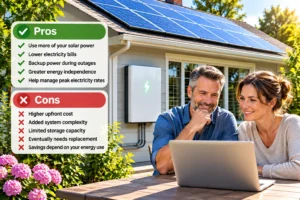
Solar Battery Storage: Pros and Cons at a Glance
In conclusion, understanding the pros and cons of solar battery storage is essential for modern energy solutions.
Evaluating the pros and cons of solar battery storage will help determine if it fits your needs.Realizing the pros and cons of solar battery storage is necessary for assessing its impact on your energy bills.Familiarize yourself with the pros and cons of solar battery storage for enhanced decision-making.
| Potential advantages | Potential disadvantages |
|---|---|
| Use more of your own solar electricity | Higher upfront system cost |
| Potentially reduce grid electricity purchases | Savings and payback are not guaranteed |
| Backup for selected loads when properly configured | Backup equipment and capacity may be limited |
| Shift energy use around time-of-use rates | Tariffs and export credits can change |
| More control over when stored energy is used | More equipment, settings and maintenance considerations |
| May support solar charging during some outages | Battery performance changes over time and eventual replacement may be needed |
When Is a Solar Battery More Likely to Make Sense?
Recognizing the pros and cons of solar battery storage can guide your decision-making process.
A battery may be a stronger fit when several of the following apply:
-
- Your solar panels regularly generate more electricity than your home uses during the day.
- You use a meaningful amount of electricity in the evening or overnight.
Reviewing the pros and cons of solar battery storage can provide insights into your energy usage.
- Your utility’s export credit is significantly lower than the rate you pay to import electricity.
- Your utility offers time-of-use rates that make storage operation useful.
- You place a high value on backup power and understand which circuits the system will support.
- The installed price and realistic bill savings make sense over the battery’s warranted service period.
When Might Solar Battery Storage Not Be Worth It?
Weighing the pros and cons of solar battery storage allows for more informed choices regarding energy use.
Storage may be less attractive when:
If you’re considering energy storage, understanding the pros and cons of solar battery storage is crucial.
- Your household already uses most of its solar electricity as it is generated.
- Your utility provides strong compensation for exported electricity.
- Your electricity rates are relatively flat, leaving little opportunity to shift usage to more valuable periods.
- The battery quote is high compared with the likely annual benefit.
- You rarely experience outages and do not place much value on backup capability.
- Your existing solar system needs expensive upgrades to support a battery.
These are decision factors, not universal rules. A battery that is not attractive on bill savings alone may still be worth considering to a homeowner who places a high value on backup power.
The pros and cons of solar battery storage can vary greatly depending on individual circumstances.
How to Decide Whether a Solar Battery Is Worth the Cost
Ask your installer for two comparable proposals: one for solar panels without storage and one for solar panels with storage. Keep the solar array size and other assumptions consistent so you can see what the battery adds.
Then work through these questions:
-
- How much surplus solar electricity do you export? Use monitoring data or a production estimate based on your household’s actual usage.
Ultimately, the pros and cons of solar battery storage will help guide your investment decisions.
-
- How much of that surplus can you use later? Consider battery usable capacity, charging opportunities and evening demand.
- What is the value of stored energy? Compare the avoided retail electricity cost with the export credit you would otherwise receive.
Many homeowners benefit from evaluating the pros and cons of solar battery storage.
-
- What are the losses and operating limits? Check round-trip efficiency, reserve settings, power output and warranty terms.
- What does backup actually cover? Get a written list of backed-up circuits and expected operating limits.
Understanding the pros and cons of solar battery storage equips homeowners for future energy planning.
- What is the incremental installed cost? Include inverter changes, backup hardware, permits and any electrical upgrades.
Do not rely on a sales estimate that assumes the battery is fully charged and discharged every day of the year. Ask for the assumptions behind the savings estimate, including seasonal production, export rates, degradation and battery replacement considerations.
Watch: Is Home Solar and Battery Storage Worth It?
This video elaborates on the pros and cons of solar battery storage and what to consider before investing.
This homeowner-experience video discusses the trade-offs of adding a battery to a solar installation. It is based on an Australian system, so treat any local incentives, tariffs and policy details as specific to that market rather than as U.S. guidance.
Key Takeaways
In summary, the pros and cons of solar battery storage remain relevant regardless of evolving technology.
-
- Solar battery storage can increase the amount of solar electricity a household uses after the panels stop producing.
- Potential benefits include lower grid imports, time-of-use flexibility and backup power when the system is designed for it.
- The main drawbacks are additional upfront cost, conversion losses, finite capacity, system complexity and eventual battery degradation or replacement.
- Financial value depends on household usage, utility import rates, export compensation, battery efficiency and installed cost.
- Solar panels paired with a battery do not automatically provide whole-home backup during an outage.
- Compare solar-only and solar-plus-storage quotes using realistic assumptions before deciding.
In light of rising energy costs, the pros and cons of solar battery storage are worth considering.
Frequently Asked Questions About Solar Battery Storage
1. What are the main pros and cons of solar battery storage?
The main advantages are using more of your own solar electricity, potentially reducing grid purchases, shifting energy use and providing backup when properly configured. The main disadvantages are the additional cost, finite storage capacity, conversion losses, system complexity and eventual battery degradation or replacement.
In summary, the pros and cons of solar battery storage should be at the forefront of your considerations.
2. Do solar batteries really save money?
They can, but savings vary. A battery may reduce the amount of electricity bought from the utility, but the financial result depends on the import rate, export credit, how much energy is stored and later used, battery efficiency and installed cost.
3. Are solar batteries worth it without a power outage?
Overall, becoming familiar with the pros and cons of solar battery storage can influence your energy choices.
They may be. A battery can shift solar electricity from daytime to evening use even if the grid is reliable. Whether that is worth the cost depends on the household’s usage pattern and utility rates.
4. Can a solar battery power an entire house?
Some systems can support a large share of a home’s loads, but this depends on battery capacity, inverter power, electrical configuration and which circuits are connected for backup. Many installations back up only selected essential circuits.
5. Do solar panels and a battery work during a blackout?
Only when the system includes compatible backup equipment and can safely isolate the home from the utility grid. Standard grid-tied solar systems generally shut down during an outage unless designed with appropriate backup capability.
The discussion on the pros and cons of solar battery storage remains relevant as technology evolves.
6. How long does a home solar battery last?
The conversation around the pros and cons of solar battery storage continues to evolve.
There is no single lifespan for every product. It depends on battery chemistry, usage, temperature, operating conditions and warranty terms. Review the manufacturer’s warranty, cycle or throughput limits and retained-capacity guarantee for the specific model.
7. Does a solar battery require maintenance?
Many modern home batteries are designed for relatively low routine maintenance, but they still require monitoring and service according to manufacturer instructions. Keep the installation area within specified environmental conditions and have faults checked by qualified professionals.
8. Can I add a battery to my existing solar panel system?
Often, yes. Compatibility depends on the existing inverter, battery system design, electrical capacity and whether backup operation is required. An installer should assess the existing equipment before recommending a retrofit.
9. Is a bigger solar battery always better?
To maximize your investment, weigh the pros and cons of solar battery storage carefully.
No. A larger battery costs more and may not be fully charged or used regularly. Size storage around the household’s surplus solar generation, evening demand, backup needs and budget.
Ultimately, the pros and cons of solar battery storage will impact your energy choices.
10. Should I buy solar panels with a battery or add storage later?
It depends on the equipment, installation cost and household priorities. Installing both together may allow the system to be designed as one integrated package, while adding storage later can spread the investment over time. Compare both options and confirm whether the initial inverter can support a future battery.
Related Solar Resources
-
- How Does Solar Battery Storage Work? – learn the basic operating principles of home batteries.
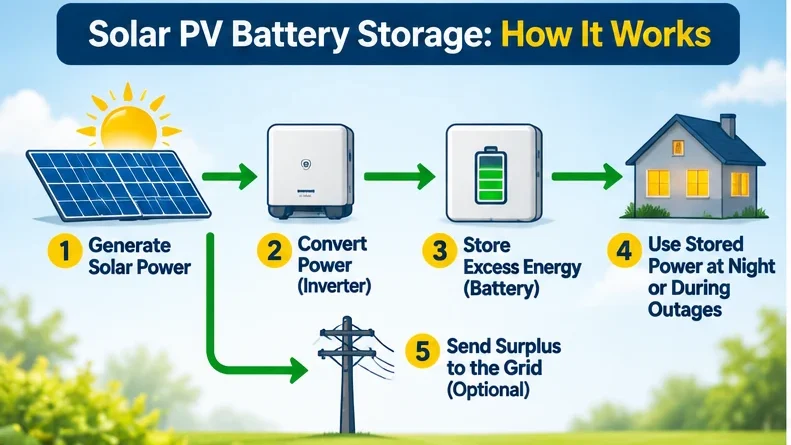
- Solar PV Battery Storage: How It Works – see how panels, inverters, batteries and the grid work together.
By understanding the pros and cons of solar battery storage, you can make better energy decisions.
- Solar Panels for Homes – explore residential solar system considerations.
- Solar Panel Cost Calculator – estimate solar costs and potential savings using your own assumptions.
Sources and Further Reading
For a deeper understanding of the pros and cons of solar battery storage, explore additional resources.
For anyone considering solar energy, the pros and cons of solar battery storage must be evaluated.